The Upgrade You Never Approved Is on Your Invoice.
June 8, 2026

Your renewal came in higher. The vendor’s explanation: AI capabilities have been added to your tier. What they didn’t say: you never asked for them, and in many agreements, you can’t remove them.
What the vendor also didn’t mention: they already know how your users are — or aren’t — engaging with those features. That information doesn’t come up during the renewal conversation. You’re negotiating a price for something they’ve already measured and you haven’t.
This is a vendor pricing mechanism dressed up as a product upgrade.
What the Vendor Is Calling an Upgrade
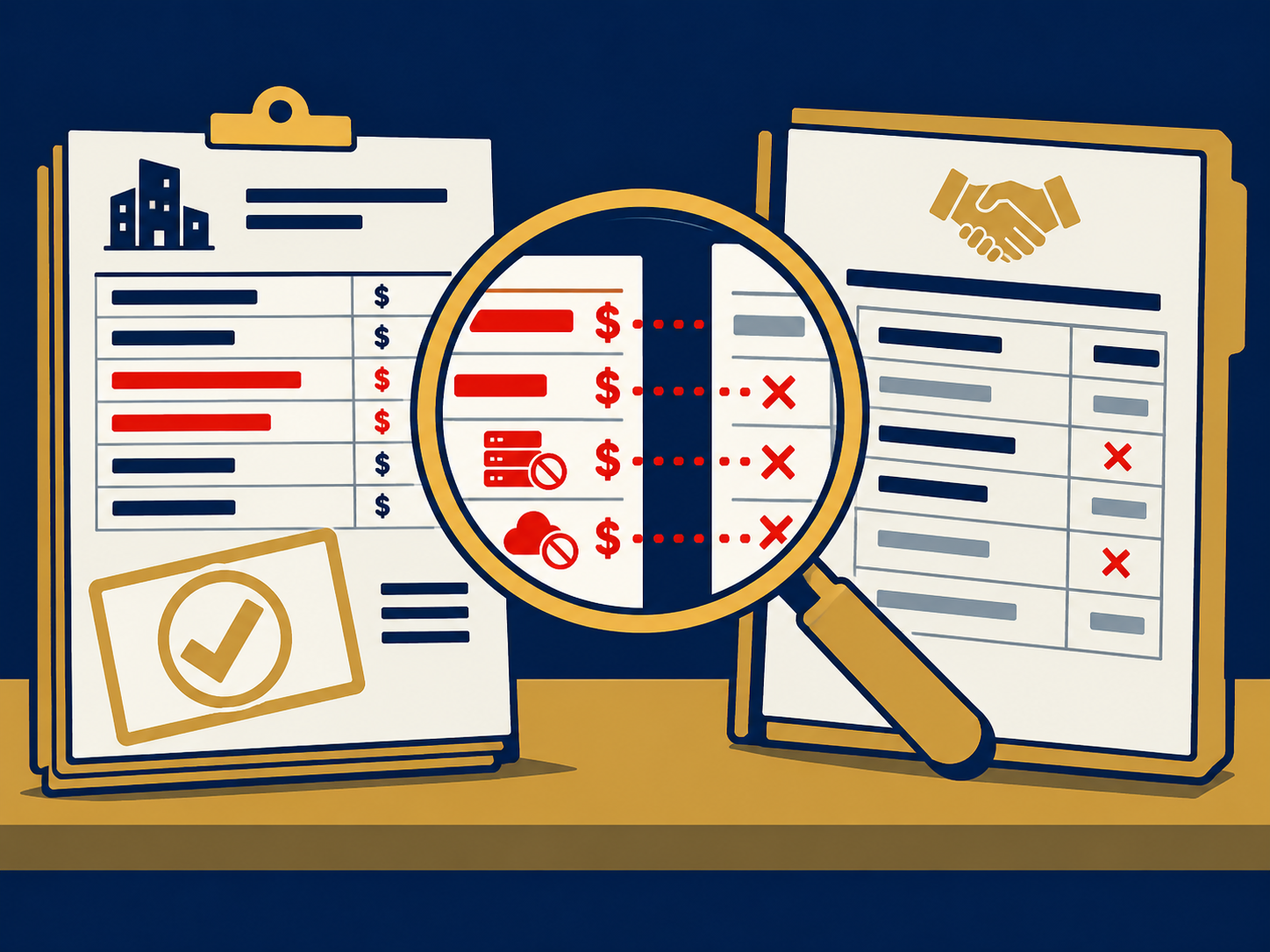
Microsoft Copilot is the most visible example right now, but the pattern runs across Salesforce (Einstein AI), ServiceNow (Now Assist), and others. The mechanism works like this: AI features get folded into existing licensing tiers or enterprise agreements — sometimes at renewal, sometimes via a mid-term “enhancement” — in ways that make it difficult to isolate what portion of the increase is tied specifically to AI. The per-seat price goes up. The justification is the new capability. The assumption is that you’ll use it — or that you won’t look closely enough to push back.
The vendor’s position is that the value is there if you want it. The buyer’s reality is that they’re funding a feature roadmap they never prioritized.
The Question You’re Not Being Asked to Ask
Most renewal conversations start from the vendor’s new number and work down from there. The buyer’s job, in this framing, is to negotiate a discount off the AI-inclusive price — not to question whether the AI should be in the price at all.
That’s the frame the vendor set. It’s not the only frame available.
The vendor’s renewal team typically has far more visibility into adoption patterns than the buyer does. How many of your users have logged in, run a prompt, and returned — they’re tracking it. You’re not negotiating blind exactly, but you’re negotiating with less information than the other side of the table. That asymmetry is worth naming before you accept the first number.
The real questions are: What portion of this renewal increase is attributable specifically to AI features? What is our actual utilization of those features over the last 12 months? And what does the contract look like if we opt out of the AI tier entirely?
In many agreements, the answer to that last question is: you can’t opt out. The AI feature set has been bundled at the tier level, not offered as an add-on. The vendor has restructured the packaging so that removing AI means downgrading to a tier that may strip other capabilities you depend on. That’s not accidental product design.
What This Costs Over a Contract Term
Microsoft’s published list price for Copilot runs $30 per user per month — $180,000 annually at 500 seats. What organizations actually sign at inside an enterprise agreement is negotiated below that. Whether yours was negotiated well is a different question, and one most buyers never get an independent answer to.
That’s before escalation clauses apply to the full contract value — including AI features you may never fully deploy. The contract you sign today is not the price you’ll pay in year three.
Before you sign a renewal that includes AI pricing, answer four questions:
- What percentage of our users actively use this feature today?
- What specific business outcome has it improved — and can we measure it?
- What portion of the renewal increase is tied specifically to AI capabilities?
- What does the agreement look like without it?
If your vendor can’t answer questions three and four clearly, that tells you something about how the pricing was structured.
What’s Actually Negotiable
The framing that “AI is now part of the platform” is a negotiating position, not a fixed reality. Several outcomes are available to buyers who push:
Tier restructuring. In some cases, moving to a different licensing tier or agreement structure can exclude the AI bundling while retaining core functionality. This requires knowing what the tier structure actually looks like — not just what the renewal quote shows you.
Phased pricing tied to adoption. Some vendors will accept language that ties AI feature pricing to verified deployment milestones. If you’re not using it at month six, you’re not paying full price for it yet. This is not offered proactively.
Removal of AI-specific escalation clauses. Even where the bundled price is fixed, escalation clauses often apply uniformly across the agreement. Negotiating a cap or carve-out on AI feature pricing before utilization is established is a real option in active negotiations.
Competitive pressure. The vendor’s renewal team knows whether you’ve been talking to alternatives. If you haven’t, they know that too. Walking into a renewal on a single-vendor track with no external benchmark is the condition that produces the worst outcomes. It is also, unfortunately, the most common one.
The Independent View of This Renewal
Most buyers negotiate AI bundling from a single data point: the vendor’s new number. What they don’t have is what the vendor already has — utilization data, peer pricing, and a clear picture of where the real floor sits on agreements like yours.
That asymmetry is exactly what we close.
When we look at a renewal with AI bundling, we separate what you’re actually using from what’s being pushed into the agreement — and put both against what comparable organizations at your size and footprint actually signed. The number in front of you is almost never the market number. Most buyers never find that out until after they’ve signed.
When we look at a renewal with AI bundling, we separate what you’re actually using from what’s being pushed into the agreement — and put both against what comparable organizations at your size and footprint actually signed. The number in front of you is almost never the market number. Most buyers never learn that until after they’ve signed — when it’s the wrong time to find out. If a renewal is on the table, start here.
If this is where you are right now
If your renewal came in higher and the explanation was AI, enhanced capabilities, or a tier change — and you haven’t independently verified what those changes actually cost versus what they’re actually delivering — you’re in the most common position we see. And the most preventable one.
The vendor already knows what’s in the agreement. Now you do too.
If you’re still in active negotiation, we’ll tell you whether the number on the table is competitive — and what the floor actually looks like at your size and footprint.
If you’re already under contract and the pricing feels wrong, that’s an optimization conversation, not a lost cause.
Either way: no pitch, no prep. Just an honest look at what’s in front of you.