When Your Board Says "AI Efficiency" — Whose Problem Is That Solving?
June 17, 2026

“AI efficiency” is everywhere right now. Board decks, vendor roadmaps, analyst briefings, earnings calls. It was the stated reason behind one in four layoff announcements in March 2026. Increasingly, it’s also the language your board reaches for when the real topic is headcount, spend, or org structure.
Before you build anything around that phrase, ask the same question you’d ask about any policy change that arrives with its reasoning already attached: who does this framing actually help?
The One Question That Cuts Through It
Whether it’s a board mandate, a vendor roadmap, or a competitor’s layoff announcement, one question separates real AI impact from borrowed talking points:
What is AI doing, in which workflow, that a person used to do — and how does the output compare to before?
Not what AI could do. Not what it did somewhere else. What is it doing here, in this environment, right now.
Here’s the difference in practice. “AI will improve support productivity” tells you nothing — it’s a category, not a fact. “AI now drafts 82% of Tier-1 responses, review time dropped from 6 minutes to 90 seconds, and CSAT held flat for six months” — that’s something you can check, replicate, or push back on.
If someone can answer the question with a specific process and a before-and-after, the claim is probably real. If the answer is a category, or a result from a different company’s deployment, it’s someone else’s story being used to justify a decision in yours.
What “One in Four” Actually Means
One in four March 2026 layoffs citing AI doesn’t mean a quarter of companies automated their way to a smaller team. It means a quarter of companies picked “AI” as the public reason for a decision made for other reasons — cost pressure, post-pandemic overhiring, margin targets, what investors wanted to hear.
“AI-driven” is doing in 2026 what “strategic realignment” did in 2015 and “digital transformation” did in 2019. It turns a financial decision into a story about technical progress. It changes the conversation from “why are we cutting” to “how do we adapt” — which is an easier conversation to have with a board, a newsroom, or your own team.
AI is genuinely changing staffing in specific roles, at specific companies, with specific tools in place. But “AI is driving this” as a blanket reason almost never holds up on its own. Usually there’s a spreadsheet and a margin target underneath it, and AI is the story that got written on top.
Where the Framing Comes From
Your board didn’t invent “AI efficiency.” It came from vendor briefings, analyst reports, and earnings calls — companies claiming 20–30% productivity gains from AI deployment. Vendors benefit when that framing sticks. If the board believes AI-driven efficiency is urgent, AI tooling becomes a budget priority, and the vendors selling it are first in line.
The vendor’s best case is not your business case.
The 25–75% overstaffing figures showing up in board conversations follow the same pattern — numbers pulled from a handful of deployments, applied broadly to support a conclusion someone already wanted to reach. Three signs the framing is borrowed rather than earned: the productivity gain comes from someone else’s deployment, the headcount decision came before anyone measured current performance, or the savings are presented without any mention of quality. If error rates climb, satisfaction drops, or compliance risk rises, the savings on paper get eaten by costs that haven’t shown up yet.
By the time “AI efficiency” reaches your desk as a mandate, it’s already passed through several rounds of people with a reason to frame it this way.
What to Do When the Mandate Lands
A board AI mandate is a starting point for negotiation, not a finished instruction. The board has a real goal — lower costs, higher output, staying competitive. AI is the frame they’re using to talk about it. Your job is to separate the goal from the frame, and figure out whether AI is actually the right tool for that goal in your environment.
That takes two things most teams don’t have on day one: an honest read on where AI can actually replace or support work in your specific stack, and an independent check on whether the vendor roadmaps in front of the board match what those vendors have delivered at companies like yours. Vendors will show you their best results. They won’t bring up where it didn’t work — at your size, on your stack, with your data.
If a board mandate is already shaping technology decisions before that check happens, this is the conversation to have — before the plan is locked and the vendor is picked.
What the Vendor Won’t Tell the Board
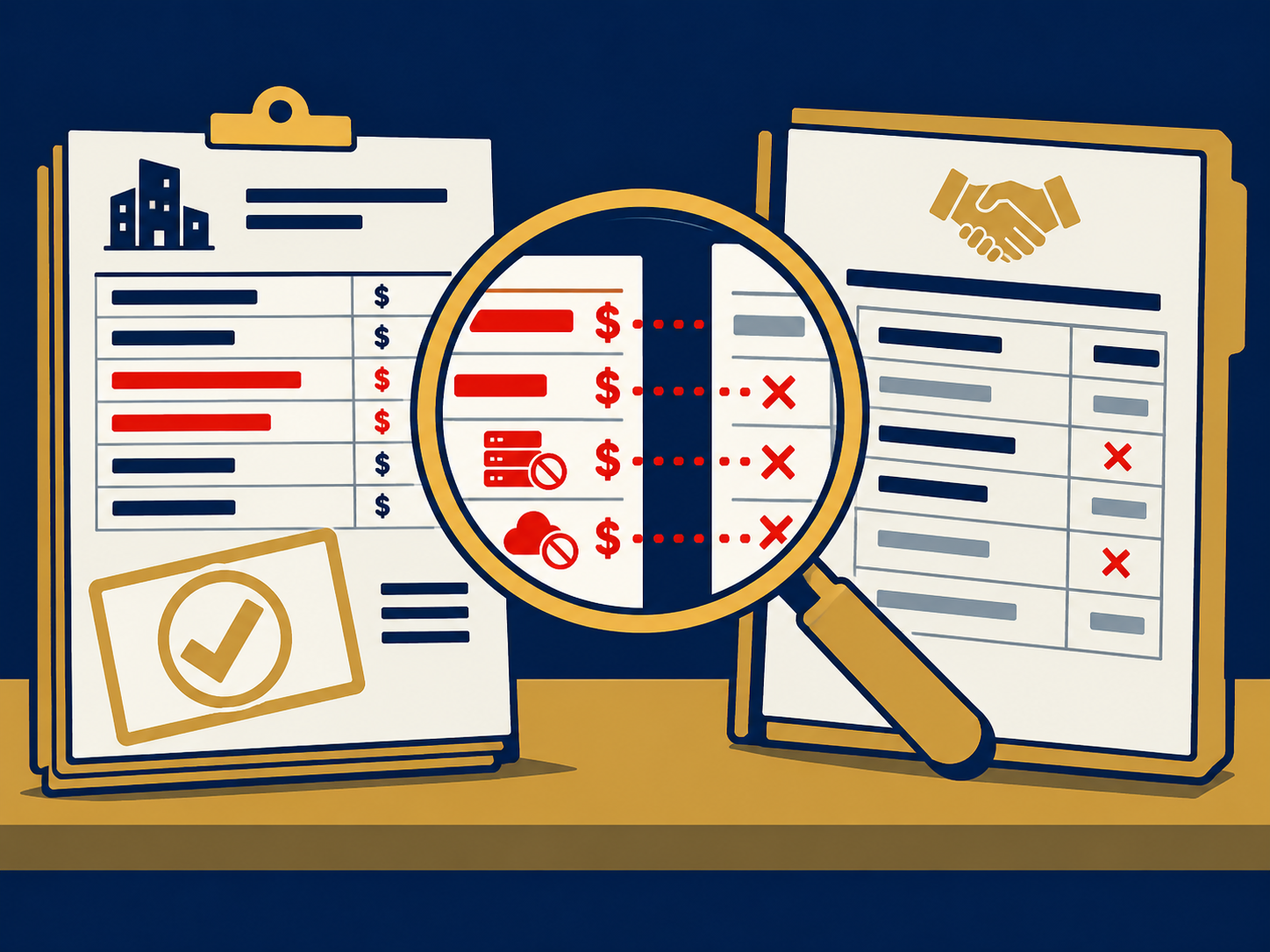
Vendors show the board their best deployment — not the one at a company your size, on your stack, with your data, where the results didn’t match the pitch.
When we work with teams navigating a board AI mandate, the first thing we do is find that gap: what’s been promised versus what’s actually been delivered at companies built like yours. That gap is almost always bigger than the board has been told.
The mandate is real. The framing it arrived in might not be. The earlier you bring us in, the more of this you can still shape. Get Started. No pitch. No prep. Just answers.