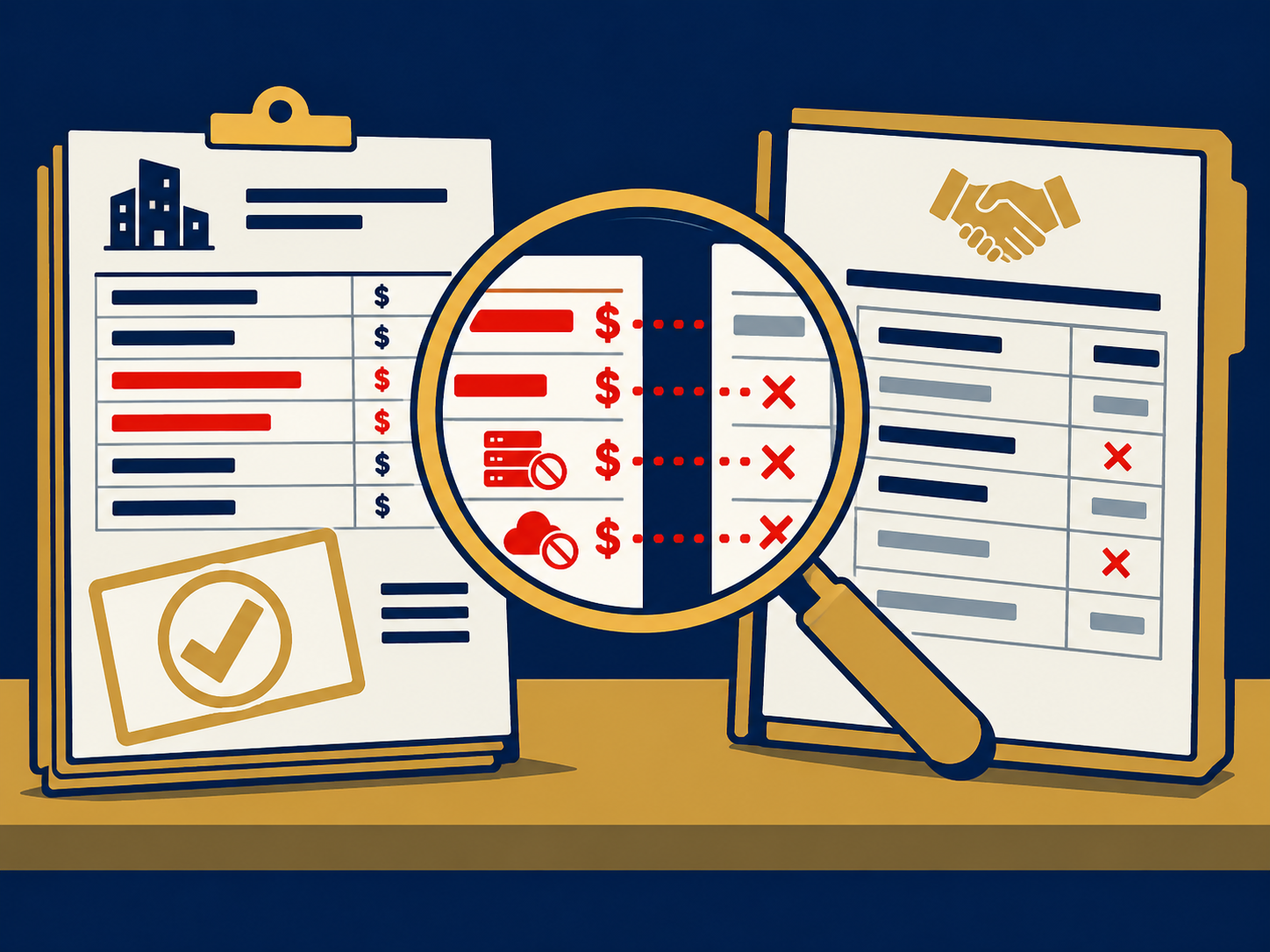
The Vendor Said Your Cyber Insurance Requires Their Product. Go Check.
June 15, 2026

The sales call ended with a line you didn’t expect: “Your cyber insurance carrier requires this.” Maybe it was an EDR platform. Maybe it was MFA enforcement at a specific tier. Maybe it was a particular SIEM or a managed detection and response provider. The implication was clear. This isn’t a choice, it’s a compliance requirement. You’re not evaluating a vendor, you’re satisfying a mandate.
Go check.
Not because vendors always misrepresent this. But because “your carrier requires it” and “your carrier prefers it” and “your carrier recommends it” and “carriers like yours typically require it” are four different statements — and in a sales conversation, they tend to blur into one.
How Carrier Requirements Actually Work
Cyber insurance carriers do issue security control requirements. This is real. Carriers have minimum security baselines — MFA, endpoint protection, backup and recovery controls, incident response plans — that policyholders must meet to be eligible for coverage or to qualify for specific premium tiers. If you don’t meet the baseline, you don’t get the policy, or you pay more for it.
What carriers generally do not do is require a specific vendor product to satisfy those controls. The requirement is typically functional: you must have endpoint detection and response capability. Which vendor provides it is usually the buyer’s choice.
The gap between “you need EDR capability” and “you need our EDR product” is where vendor sales teams operate.
Where the Vendor’s Claim Comes From
Cyber insurance carriers maintain relationships with security vendors. Some carriers publish preferred vendor lists — technology partners they’ve evaluated and consider strong implementations of required controls. Being on that list matters commercially: it gives the vendor’s sales team a tool. “We’re on your carrier’s preferred list” is a different conversation than “here’s our product.”
How vendors get on those lists varies. Some earn placement through genuine technical evaluation. Some get there through commercial partnerships — co-marketing arrangements, referral relationships, or direct engagement with carrier risk teams. This creates a commercial ecosystem most buyers never see. The carrier’s recommendation looks independent. The vendor’s preferred status looks like a neutral assessment. The buyer rarely has visibility into the commercial relationship behind the recommendation.
What “Required” Usually Means in Practice
When a vendor says your carrier requires their product, there are several possible realities behind that claim:
The carrier has a published list of approved vendors for a specific control, and this vendor is on it — but so are several others. “Approved” became “required” somewhere in the sales conversation.
The carrier has issued a requirement for a functional control category, and the vendor meets it — but so do a dozen competitors at different price points. The vendor’s framing collapsed “meets the requirement” into “is required.”
The carrier has a preferred vendor relationship with this specific vendor — a commercial arrangement that benefits both parties. The vendor’s sales team describes this as a carrier endorsement.
Sometimes the urgency comes from broader industry trends rather than a specific carrier requirement for your policy.
In none of these cases does “your carrier requires our product” mean what it sounds like it means.
How to Verify Before You Sign
The verification is simple. Contact your broker or carrier directly — not through the vendor, not through a referral link the vendor provides — and ask two questions:
First: Does my policy or renewal require a specific vendor product, or does it require a functional security control that any qualified vendor can satisfy?
Second: Is this vendor on an approved or preferred list, and if so, what is the basis for that designation?
Most brokers will answer this directly. If the vendor’s claim holds up, you have confirmation and can proceed with more information than you had. If it doesn’t, you’ve just changed the negotiation entirely.
The vendor’s urgency — the implicit pressure of “you need this for your insurance” — evaporates the moment you verify independently. What you’re left with is a product evaluation on its merits, against alternatives, at a price you haven’t yet negotiated.
The Broader Pattern
Cyber insurance requirements are tightening. This is real and the trend is not going away. Carriers are raising minimum security baselines after years of significant loss ratios, and the controls they’re requiring are more specific than they were three years ago. Vendors know this. The timing of the requirement narrative — deploying it at renewal, at a compliance deadline, after a peer incident — is not accidental.
The vendors who benefit most from this environment are the ones who’ve invested in carrier relationships ahead of the market shift. They’re positioned as the answer to a requirement before the buyer has confirmed the requirement exists in the form the vendor described it.
What This Looks Like From Our Side
The vendor’s version of the requirement and the carrier’s actual requirement language are rarely the same document. When we pull the real control language — not the vendor’s interpretation of it — the specific product mandate usually disappears. What’s left is a functional requirement, a real market of vendors who satisfy it, and a negotiation that hasn’t started yet.
If a cyber insurance renewal or a new vendor requirement is in front of you, start here →
A security vendor told you your carrier requires their product. You haven’t verified that with your broker or carrier directly. The verification costs nothing. What you find on the other side of it might.