Your Headcount Dropped. Why Didn't Your IT Spend?
June 19, 2026

When a company reduces headcount, the org chart changes immediately. The vendor contracts don’t.
Seats stay active. Support tiers stay sized for the old team. Infrastructure commitments stay at the capacity level that made sense when you had more people running more workloads. Licenses tied to employees who left keep renewing at the same volume.
Most organizations have a process for offboarding employees. Far fewer have a process for offboarding the spend attached to them.
What Doesn’t Adjust Automatically
The categories where overpayment builds up fastest after a layoff are predictable.
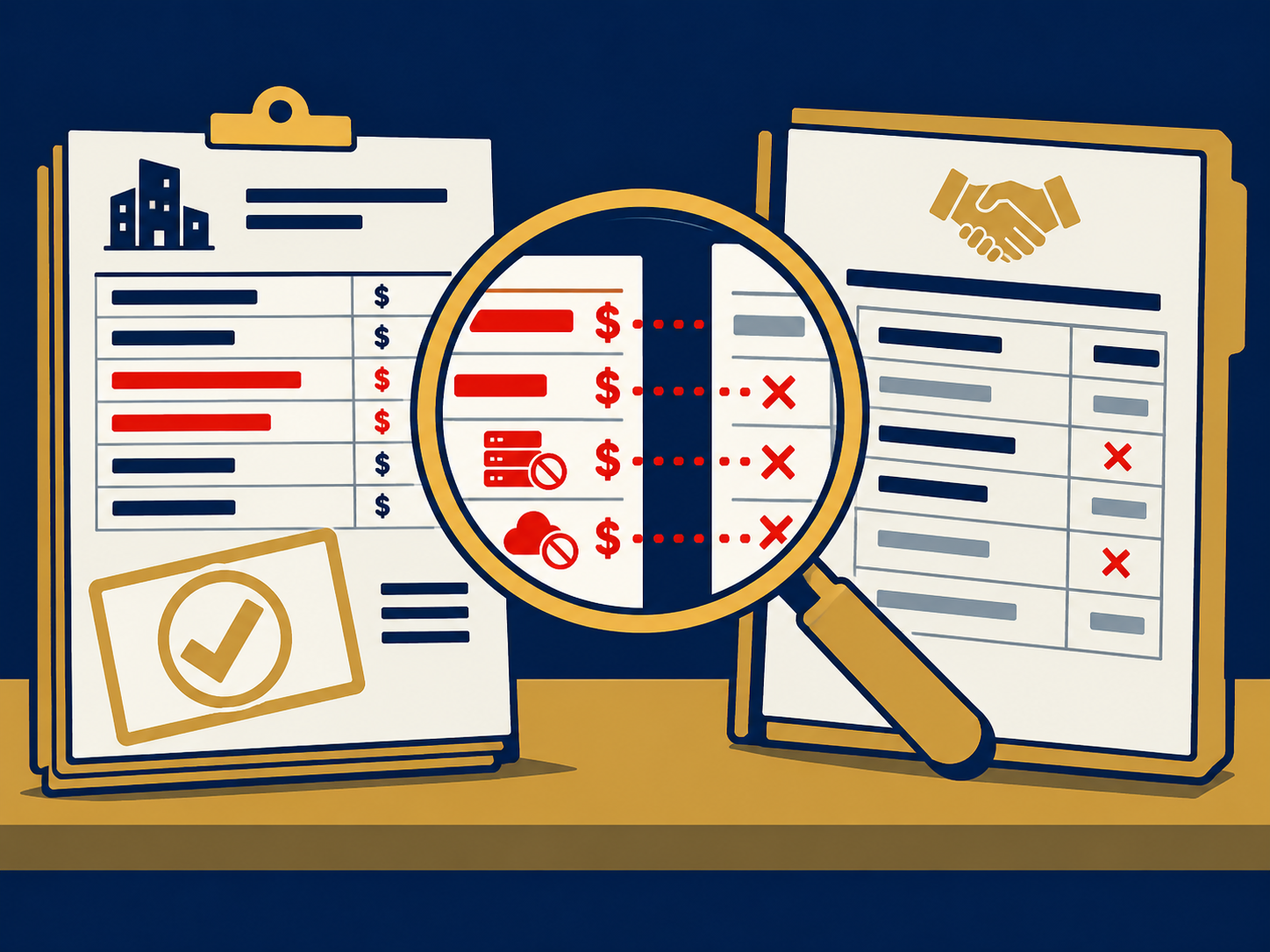
Software licenses are the most visible. Per-seat SaaS contracts sized for your old headcount don’t scale down on their own. The licenses often sit provisioned but unassigned — still billing, no longer used. Your HR system shows departed employees. The vendor’s system shows active licenses. Nobody connects the two until someone goes looking.
Support tiers are less visible but often cost more. Enterprise and premium support contracts are sized to the complexity and volume of the environment they were built for a larger team running more workloads. After a layoff, that tier is frequently one level higher than what the remaining team actually needs.
Infrastructure and managed services carry the biggest exposure and are the hardest to unwind. Cloud commitments, colocation, bandwidth, and managed service agreements are all sized against projected usage. When headcount drops and workloads shrink, the contract doesn’t — because the term runs on its own clock, independent of what’s actually happening in your environment. This is where the largest and least visible overpayment tends to sit.
Why the Invoice Looks the Same
The simple answer to “why are we still paying for this” is “nobody checked.” That’s true, but it’s not the whole story.
The mismatch doesn’t announce itself. Your monthly invoice looks the same after a layoff as it did before — same line items, same totals. The budget absorbs it as normal, because the spend pattern hasn’t changed. Only the headcount that justified it has. Unless someone is actively comparing team size against vendor footprint, the gap stays invisible.
Vendor billing systems aren’t built to track your org chart — they’re built to bill against the contract you signed. What’s changed since then is something you have to surface. They won’t.
The Window Closes Faster Than You Think
Most teams don’t find this mismatch until the next renewal — six, nine, sometimes twelve months after the layoff. By then, the vendor has collected months of overpayment, the budget has absorbed it as baseline, and the layoff itself feels like old news rather than an active problem.
The window to fix this closes quietly, without anyone noticing it was open.
Here’s why timing changes the conversation. A CIO who reaches out three weeks after a layoff and says “our team changed significantly, we need to revisit the scope” is having a natural, expected conversation. A CIO who raises the same point eleven months later — after the vendor has collected nearly a year of overpayment and the contract is heading toward auto-renewal — is fighting an uphill one.
The longer the gap between the layoff and the audit, the more normal the overspend looks, and the harder it is to argue your current pricing should reflect your current environment.
How to Find the Mismatch
The audit means lining up three things: your current headcount and team structure, your current vendor contracts and commitments, and your actual usage data wherever the vendor provides it.
Start with your highest per-seat cost contracts — core SaaS platforms, security tools, productivity suites. Pull the current license count and compare it to active users over the last 30 days. The gap between the two is your immediate exposure.
Next, look at support tier contracts. Pull the current tier and what it covers. Compare that to the size and complexity of the team actually using support today. In most post-layoff environments, the tier is at least one level higher than needed.
Infrastructure and managed services need usage data, not headcount comparisons. Pull actual consumption against contracted minimums. Any consistent gap between what you’re committed to and what you’re using is a renegotiation conversation waiting to happen — and it’s the one most teams miss, because it doesn’t show up on any per-seat report.
What you end up with is a list of contracts where the terms no longer match your environment, ranked by dollar exposure and by how close each one is to its next renewal.
What to Do With What You Find
A mismatch between your environment and your contracts is a negotiation opportunity — but only if you raise it before the renewal locks it in as the new baseline.
The conversation itself is simple: your environment changed, you want the contract to reflect your current footprint, and you’re raising it now because this is the right time. Most vendors would rather adjust the scope than risk the account. The ones who push back hardest are usually the ones with the most to lose from the conversation — which tells you something on its own.
Going in, you need the same thing you’d need for any renewal: independent data on what comparable organizations your size are actually paying for the same services. Without that, right-sizing just means negotiating against the vendor’s number instead of the market’s.
If a layoff happened recently and nobody’s run this audit yet, this is where that conversation starts. The window is open. It closes at renewal.
The Vendor Isn’t Waiting
Your vendor knows your renewal date. Their account team is measured on renewal revenue. A contract that renews at your pre-layoff rate is a better outcome for them than one that gets right-sized to your current environment.
The question isn’t whether they’ll bring this up. They won’t. The question is whether you find it before the renewal locks it in, or after.
If you’re carrying costs that don’t match your current team, that’s what Optimization is for. Get Started.
No pitch. No prep. Just answers.