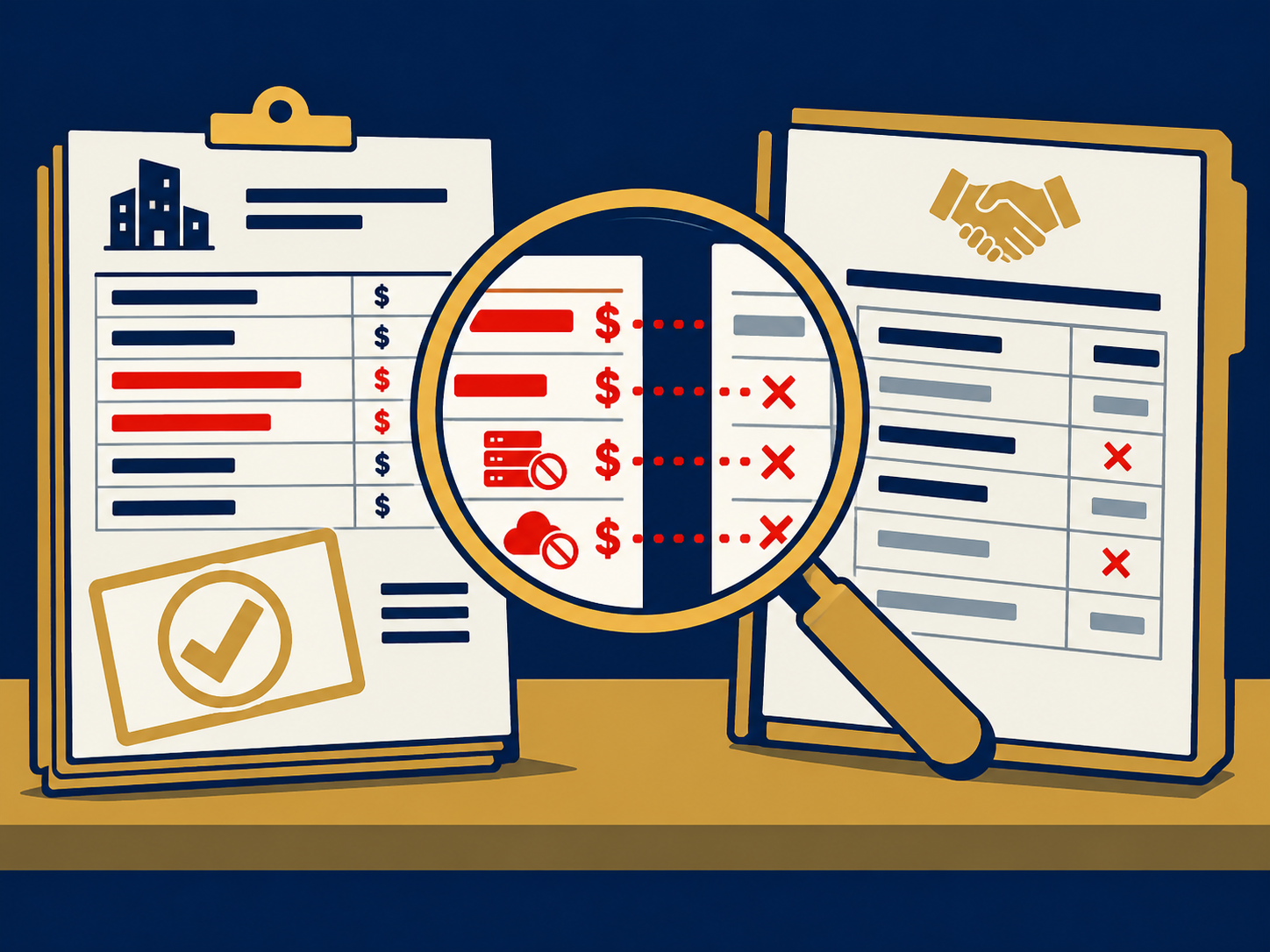
Telecom expense management (TEM) is the practice of keeping an accurate inventory of an organization’s telecom services, checking carrier invoices against contracts and usage, and removing services that are wrong or no longer needed. It can be done in-house with software, or bought as a managed service from a provider that loads the invoices, runs the audits and pursues the credits.
At a glance
- TEM ties together three records that usually live apart: the service inventory, the contracts and the invoices.
- Invoice audits look for charges that don’t match contracted rates, services that should have been disconnected, and incorrect taxes and fees.
- Scope usually includes circuits, voice and data services, and often mobile; it varies by provider.
- It can be delivered as software, a managed service, or both.
- Savings come from acting on findings: disconnects, disputes and renegotiation at renewal.
What problem it solves
Telecom bills are hard to read and easy to ignore. A mid-sized company can have dozens of accounts across several carriers, each with its own invoice format, and services that were ordered years ago by people who have since left. Offices close but their circuits keep billing. Promotional rates expire, contracts roll onto month-to-month pricing, and errors on the invoice are paid because nobody checks them against the contract.
TEM gives finance and IT a single, current picture of what services exist, where they are, who owns them, what they should cost and what they actually cost. That picture supports disconnecting what isn’t used, disputing what is billed wrongly, and going into renewals knowing what you have.
How it works
Inventory. The first step is building a list of every service: circuit IDs, phone numbers, accounts, locations, contract terms and owners. This usually means collecting invoices and carrier records and matching them to what is actually in use, which can take weeks on its own.
Invoice processing and audit. Invoices are loaded, either electronically from carriers or from paper or PDF bills, and compared with the inventory and contract rates. Audits look for rate errors, duplicate charges, services that should have been disconnected, unexpected usage and wrong taxes or fees. Many providers file disputes with the carrier on your behalf and track credits until they appear; with software-only products, your team does that work.
Cost allocation. Charges are assigned to departments, sites or cost centers for budgeting and chargeback.
Contract and lifecycle management. Renewal dates and notice windows are tracked, and adds, moves, changes and disconnects go through an approval process so the inventory stays accurate. Some providers also help with sourcing and renegotiation, which can overlap with what a telecom advisor or broker does.
Mobile lines can be handled within TEM or through a dedicated wireless expense management (WEM) service. See our telecom expense management page for how programs are typically structured.
When it matters for buyers
- When telecom spend is spread across many sites and carriers. The number of invoices, not just the total, drives the need.
- After an acquisition. Two inventories, overlapping services and contracts nobody fully understands.
- When a new CFO or finance leader starts asking questions. TEM produces the answers.
- Before contract renewals. An accurate inventory and usage history are your negotiating position.
- After closing or consolidating offices. Services at closed sites are a common source of waste.
Questions to ask vendors
- Which service types and carriers can you process, and in which countries?
- How do you build the initial inventory, and how long does it take?
- Do you file and follow up on disputes, or do we?
- How is your fee calculated, and how are savings defined and verified?
- How far back will you audit, and how do you handle carrier dispute deadlines?
- How do you keep the inventory accurate as services are added and removed?
- Can we export our inventory and invoice history if we leave?
How it differs from wireless expense management (WEM)
Wireless expense management (WEM) applies the same ideas to mobile lines, plans and devices, where the problems are different: many individual users, shared data pools, device purchases and upgrades, international roaming, and lines that need to be suspended or reassigned when people leave. TEM is the broader umbrella for all telecom spend. Many TEM providers include mobile, while some organizations buy a separate WEM or managed mobility service because their mobile estate is large or complex.
Problems this helps with
- Paying for circuits and phone lines at sites we closed years ago
- Dozens of carrier invoices nobody checks
- Not knowing what services we have or when contracts end
- Billing errors that never get credited