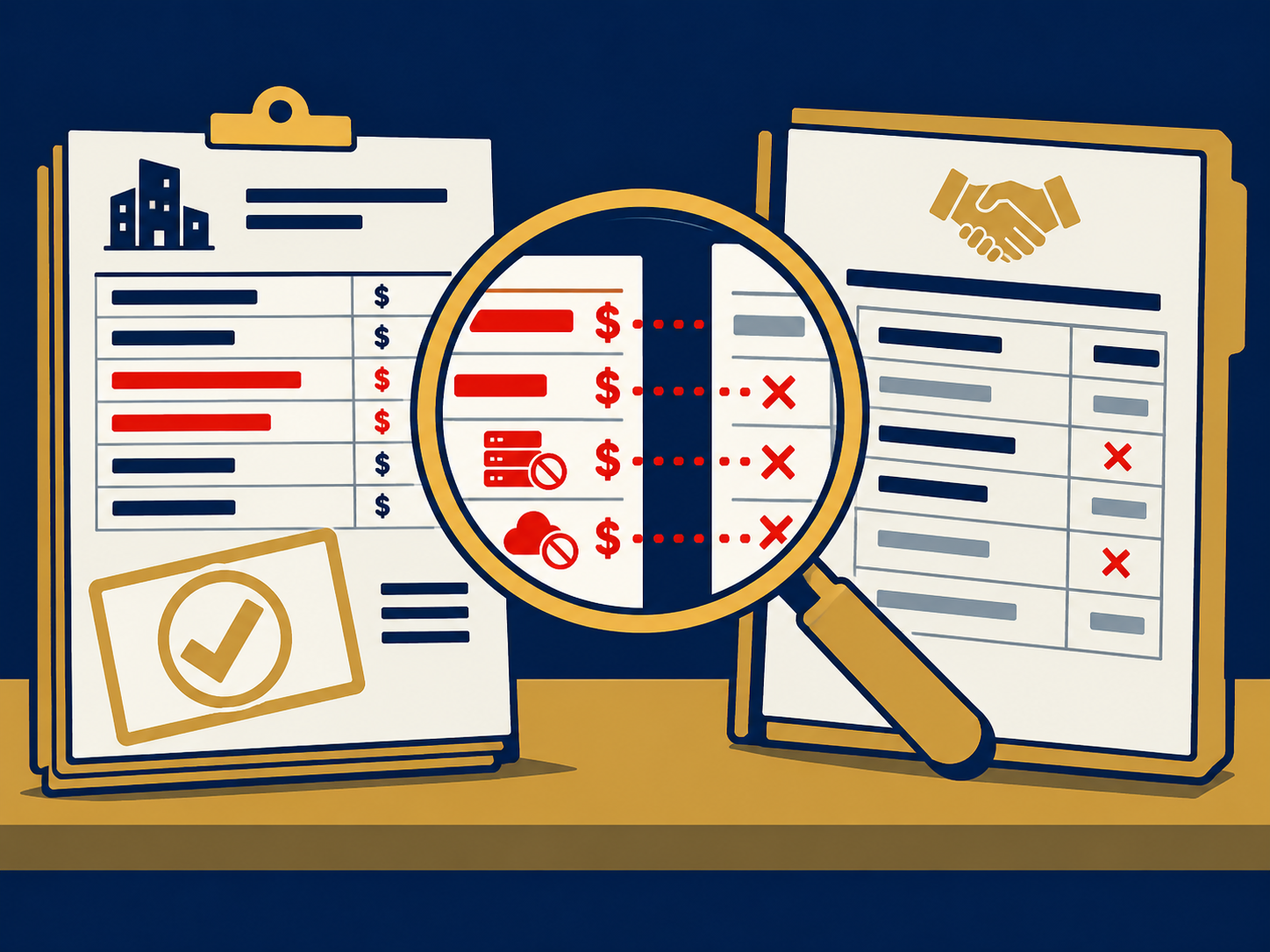
You pushed back on the first number. The rep went quiet for a day, came back with 20% off, and called it the best they could do.
You signed.
What you probably didn’t know: in many enterprise sales organizations, a discount like that sits inside the rep’s approval authority before the conversation even begins. They didn’t fight for it. They waited for you to ask.
Vendor pricing systems are designed to look like negotiations. Understanding how they actually work, what the approval structure reveals, and what a 15% pricing gap on a 500-seat agreement costs over three years is the starting point.
Most IT leaders assume a pricing mistake costs a few percentage points. It rarely stops there. Over a three-year agreement, the difference between a standard discount and a market-competitive one affects budget flexibility, staffing decisions, project funding, and the ability to invest elsewhere. Pricing is not a procurement issue. It is a resource allocation issue.
The answer, before you do the math: it’s often hundreds of thousands of dollars. And the gap is almost never visible from inside the negotiation.
The Negotiation Started Before You Entered the Room
Every enterprise technology vendor of meaningful size has a pricing structure that exists before any buyer conversation begins. It includes a list price, a set of discount bands, approval thresholds at each band, and a floor: the lowest number the company will accept for a deal of your size, term length, and competitive situation.
The rep knows roughly where all of this sits before the first demo. Their CRM has a field for expected discount. Their manager has reviewed the deal. Their quota attainment for the quarter shapes how motivated they are to move.
By the time you’re in the negotiation, you are the only person at the table who doesn’t know where the number can go.
How Vendor Pricing Approval Actually Works
While discount thresholds vary significantly by vendor, category, and competitive situation, most enterprise sales organizations use a similar approval structure: increasing discounts require increasing levels of justification and oversight. A security vendor may discount 60 percent on the right deal. An infrastructure vendor may barely move 10 percent. What matters is not the specific percentage but recognizing which level of the approval structure you are in at any given moment.
At the first level, the rep has direct authority to offer modest discounts without escalation. These moves happen fast. If your rep comes back within hours, you are being handled at the lowest level of their process. The number can move further.
At the second level, discounts require sales manager sign-off and some justification. The justification is usually thin: competitive pressure, deal timeline, relationship history. If the rep asks for a day to talk to their manager, this is where they are. The number can still move.
At the third level, deeper discounts require deal desk review. Finance, legal, and revenue operations are now involved. The process takes longer. The vendor starts asking questions about deal structure: term length, payment schedule, expansion potential. They are no longer pricing a transaction. They are deciding whether this deal is worth the margin.
At the fourth level, the largest discounts require executive approval and specific strategic justification. Competitive displacement from a named alternative. A multi-year commitment with significant expansion potential. A logo that serves as a reference customer in a market they want to penetrate. These deals get done. They require the buyer to bring something the vendor actually wants in exchange.
In one engagement, a company negotiating a security platform pushed the price to $125 per seat and considered it a win. Their team had moved from $150 to $135 to $125, a 17 percent reduction. Based on comparable transactions at similar company sizes and contract structures, the market was clearing closer to $65 per seat. The buyer never reached the third level of the approval process. They stopped at the second and ran out of road.
When to Ask These Questions
When a discount arrives, three questions change the trajectory of the negotiation.
Has this discount already been internally approved, or does it require escalation? The answer tells you exactly where you are on the approval ladder. A rep who can answer immediately is operating within their own authority. A rep who needs to check is telling you there is a process above them.
What would need to change structurally to get additional movement? This shifts the conversation from price to deal architecture. Term length, payment terms, expansion commitments, reference rights: these are the levers that unlock deeper approval levels. If the vendor starts engaging on structure, you have reached a level where price alone is no longer the variable.
Are we still talking about price, or have we moved to deal structure? This distinction is the most important signal in the negotiation. When vendors stop talking about the discount and start talking about what the relationship looks like over the next three years, you are either near their floor or they are trying to shift the conversation away from it. Knowing which one matters.
How to Tell When You Have Reached the Real Floor
Most buyers stop negotiating before they reach the vendor’s actual floor. The reason is rarely a lack of leverage. It is a lack of signals. These are the observable indicators that you are approaching the end of the pricing conversation.
Discount discussions stop and contract structure discussions start. The rep is no longer responding to price requests. They are asking about term length, payment timing, and expansion commitments. This is not evasion. It is the deal desk telling you through the rep that the next concession requires something in return.
The vendor asks for concessions. When a vendor starts asking what you can offer in exchange for additional movement, you are at a level where price alone is no longer sufficient justification. This is leverage, not a dead end.
Additional reductions require longer terms. A one-year agreement will not get to the same place as a three-year agreement. If the vendor starts tying deeper discounts to multi-year commitments, they are telling you where their approval threshold sits.
Price freezes and implementation credits appear. When the number stops moving but the vendor starts offering professional services, onboarding support, or implementation credits, you have reached the price floor for this structure. They are willing to add value in ways that do not reduce the contract price on the books.
Executive approval is mentioned. If your rep tells you they need VP or C-level sign-off to go further, you are at the fourth level of the approval structure. This is a meaningful signal. Vendors do not escalate routine deals to executive approval. Something about the size, competitive situation, or strategic value of your account has made this worth their attention.
The Problem No Discount Solves
The approval ladder tells you how far you have moved inside the vendor’s pricing system. It does not tell you whether the system’s floor is competitive.
A vendor’s lowest approved price is not the same as the market rate for your situation. Most buyers discover the difference at their second or third renewal, when they have enough context to understand that their best deal was still above what comparable companies signed.
The structural problem is that the buyer has no equivalent to the vendor’s pricing data. The vendor’s system contains every deal they have ever closed at your company size, in your industry, in your region, on your contract structure. They have significantly more pricing data than you do. You know what they told you.
That gap does not close through better tactics or harder pushing. It closes through independent data: what comparable companies actually paid, from contracts negotiated recently, at your scale, with your use case. The challenge is not reaching the vendor’s floor. The challenge is knowing whether that floor is competitive before you accept it.
What changes with independent representation is not the negotiation itself. It is the information going into it. Knowing what competitive transactions look like once vendors have exhausted their standard approval paths and deals have reached executive review is a different starting point than knowing only what your vendor told you.
One more thing worth naming: the initial discount is often not where the real money is. The terms that govern the next three years, renewal price caps, escalation clauses, true-up language, expansion pricing, these determine what you actually pay over the life of the relationship. Sophisticated buyers focus as much on preventing future increases as on the number they sign today.
Is This You?
Your vendor just returned with a 15 to 20 percent discount and called it their best offer. You are heading into a renewal and the rep is talking more about the relationship than the price. You signed a deal that felt like a win and you are now, a year later, not certain it was.