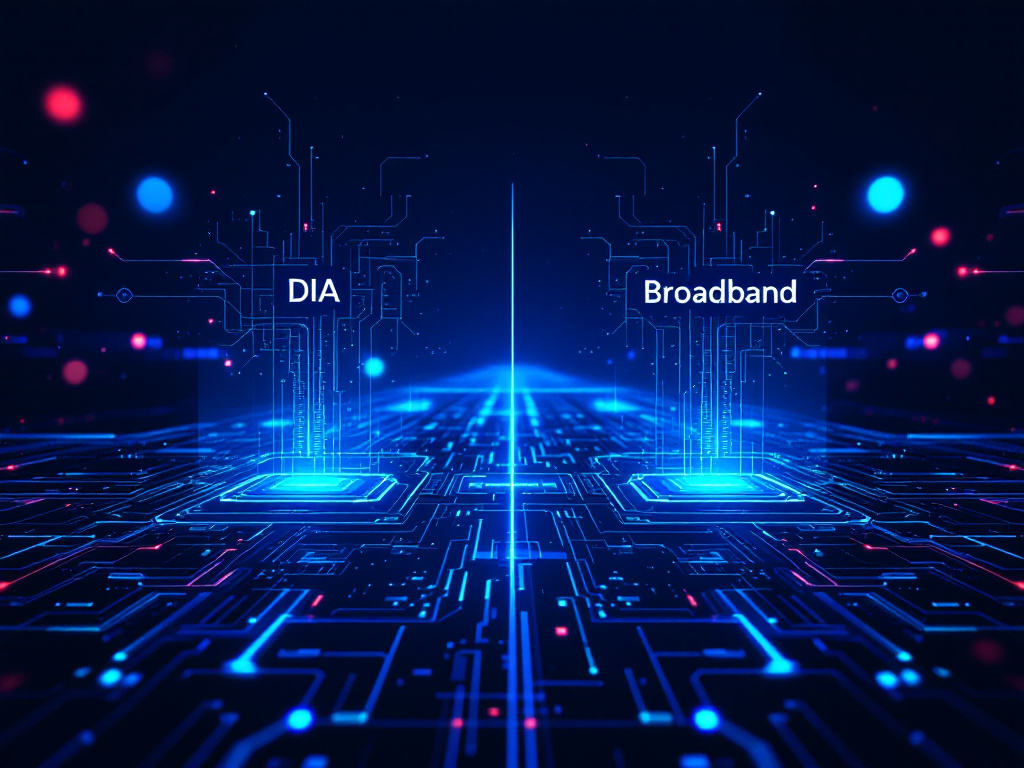
The choice between dia vs broadband is about more than monthly fees, it’s about predictable performance, reliable uptime, and secure connectivity for your critical business applications. Broadband internet may look attractive at first glance, but its shared infrastructure and best-effort service model can undermine productivity, frustrate users, and expose you to security risks. Dedicated Internet Access delivers symmetrical speeds, stringent Service Level Agreements, and a private connection, ensuring you get the performance you pay for.
In this comparison you’ll learn when a lower-cost broadband plan actually costs you more in downtime, productivity loss, and hidden fees—and why investing in Dedicated Internet Access can pay off over time. We’ll cover performance, cost, deployment, security, and practical guidance to help you decide which option best fits your organization’s needs.
Understanding DIA vs Broadband
Dedicated Internet Access, or DIA, provides a private, uncontended connection exclusively for your business. Unlike broadband internet, which shares bandwidth among multiple customers, DIA uses leased lines or private fiber-optic networks to deliver guaranteed downstream and upstream speeds. With symmetrical rates—say 1 Gbps up and down—and network paths designed for minimal congestion, you can count on consistent performance.
Broadband internet includes DSL, cable, fiber, wireless, satellite, or Broadband over Powerlines (BPL). These technologies share local network resources across many users, leading to variable speeds and potential bottlenecks during peak hours. Upload speeds tend to be slower than downloads, and providers typically offer no uptime guarantees or formal Service Level Agreements.
Key distinctions at a glance:
- Dedicated vs Shared Bandwidth: DIA offers a 1:1 contention ratio, whereas broadband contends with up to 60 users per segment.
- Symmetrical vs Asymmetrical Speeds: DIA delivers the same upload and download rates, ideal for VoIP, video conferencing, and cloud backups.
- SLA-Backed Reliability: DIA contracts include credits or concessions if performance targets aren’t met, see our guide on dia uptime for details.
- Private vs Public Infrastructure: A dedicated circuit reduces exposure to neighbor noise, congestion, and shared-network vulnerabilities.
To dive deeper into how DIA works and what options you have, check out our dedicated internet access overview.
Comparing Performance Characteristics
Bandwidth and Speed
Broadband plans often advertise headline speeds—1 Gbps download, for example—but those rates aren’t reserved exclusively for you. During busy periods your throughput can drop below advertised levels. If your team uploads large files, streams HD video, or relies on real-time collaboration tools, slower or fluctuating upstream rates will hurt productivity.
With DIA you get guaranteed bandwidth. A 1 Gbps DIA circuit delivers that capacity around the clock, so your upload-intensive tasks run at full speed. You avoid unpredictable congestion and ensure applications like hosted PBX, video calls, and cloud storage work seamlessly.
Reliability and Uptime
Shared broadband infrastructure is prone to outages and performance degradation. When one neighbor engages in heavy downloads or a regional maintenance window hits, your service quality suffers. Providers seldom guarantee repair windows or credits for downtime.
In contrast, DIA SLAs commit to high availability—often 99.9 percent or better—and specify repair times. If an outage occurs, you’ll receive priority support and compensation if the provider misses targets. For an in-depth view of reliability metrics, see our article on network reliability.
Latency and Consistency
High latency and jitter disrupt voice and video calls, slow database transactions, and degrade user experience in interactive applications. Broadband routing can send your traffic over congested or suboptimal network paths, increasing round-trip times.
DIA circuits sit on dedicated backbones with optimized peering arrangements, minimizing hops and queuing delays. Consistent latency means predictable response times for trading platforms, remote desktops, and customer-facing services. In mission-critical environments, low jitter and packet loss translate directly into fewer dropped calls and smoother data transfers.
Evaluating Service Costs
Direct Service Costs
At face value a 1 Gbps broadband plan may cost around $230 per month, while a comparable DIA circuit runs about $1,500 per month. That gap can seem hard to justify if you’re only measuring sticker price. Broadband appeals to small and medium-sized businesses on tight budgets, and its quick self-installation makes it easy to deploy.
However, the lack of SLA guarantees, shared speeds, and asymmetrical upload rates limit broadband’s suitability for businesses with real-time and high-availability requirements.
Hidden and Indirect Costs
When broadband performance falters, indirect costs add up fast:
- Downtime Impact: Lost revenue during outages or slowdowns
- Productivity Loss: Employee idle time waiting on slow uploads or downloads
- Customer Satisfaction: Poor call quality or slow web services risk client churn
- Security Exposure: Shared infrastructure increases attack surface and potential data leaks
In data-driven operations, even a few minutes of degraded connectivity can cost hundreds in lost orders or support escalations. A DIA investment reduces those risks, often recouping its price premium through fewer incidents and faster issue resolution.
Assessing Deployment Flexibility
Setup Timeline
Broadband leverages existing municipal or private lines, so many plans offer same-day or next-day activation. DIA typically requires a custom line build—especially in underserved locations—which can take several weeks, depending on provider capacity and permitting.
During your planning phase, factor in lead times. If you’re under a tight deadline, broadband may bridge the gap until your DIA circuit is ready for production.
Scalability Options
Broadband upgrades often max out at standard tiers—100 Mbps, 500 Mbps, or 1 Gbps—with limited intermediate options. DIA providers let you scale in modest increments—2 Gbps, 5 Gbps, or 10 Gbps—as your needs evolve.
If you’re evaluating different line types, see type 1 vs type 2 internet for a technical breakdown, or learn how to detect type 2 circuits on your premises. That insight helps you choose the right architecture and avoid costly rewiring later.
Security and Compliance
A shared broadband connection increases your network’s exposure to external threats. Malicious traffic from neighboring customers can lead to spill-over attacks, and you lack direct control over upstream filtering. Broadband providers may offer optional security services, but they typically lack the granularity and enforcement guarantees of managed DIA circuits.
With Dedicated Internet Access you get a one-to-one link between your premises and the provider’s network edge. That private path reduces risk and simplifies compliance with standards like PCI DSS, HIPAA, or SOC 2. Many DIA packages include managed firewalls, intrusion detection, and 24/7 monitoring, giving you both technical controls and contractual assurances.
Selecting the Right Option
Choosing between broadband and DIA comes down to your business requirements, risk tolerance, and budget:
- Small Offices and Remote Sites
If you have fewer than ten users and handle light web browsing or email, broadband may suffice. It’s cost-effective and quick to deploy. - Voice and Video Collaboration
For clear VoIP calls and HD video meetings, symmetrical upload speeds and low latency are critical. DIA ensures consistent performance. - Data-Intensive Workloads
If you regularly back up large volumes to the cloud or transfer big data sets, the upload rates on broadband will slow you down. DIA keeps transfers predictable. - High-Availability Demands
For e commerce, call centers, or trading desks, downtime directly hits your bottom line. SLA-backed DIA minimizes downtime costs. - Security and Compliance Needs
When you must meet strict regulatory requirements, the private connection and managed security of DIA offer stronger safeguards than shared broadband.
Summarizing Key Takeaways
In a pure price comparison, broadband looks like the clear winner. Yet when you factor in performance consistency, uptime guarantees, security controls, and indirect costs, Dedicated Internet Access often delivers a stronger return on investment. DIA gives you:
- Guaranteed symmetric speeds for upload-heavy tasks
- SLA-backed reliability and rapid issue resolution
- Low latency and minimal jitter for real-time applications
- Private circuits that simplify compliance and reduce risk
- Flexible bandwidth scaling as your business grows
Before you commit, map your use cases, quantify the cost of downtime, and weigh the value of assured performance against your budget constraints.
Need Help With Connectivity?
Need help with choosing the right internet connectivity for your business? We specialize in matching organizations with the solution that aligns to their performance, reliability, and security requirements. Whether you’re exploring DIA options or optimizing existing broadband links, we guide you through vendor selection, contract negotiations, and implementation planning. Let’s find the connectivity approach you can defend—get in touch today.