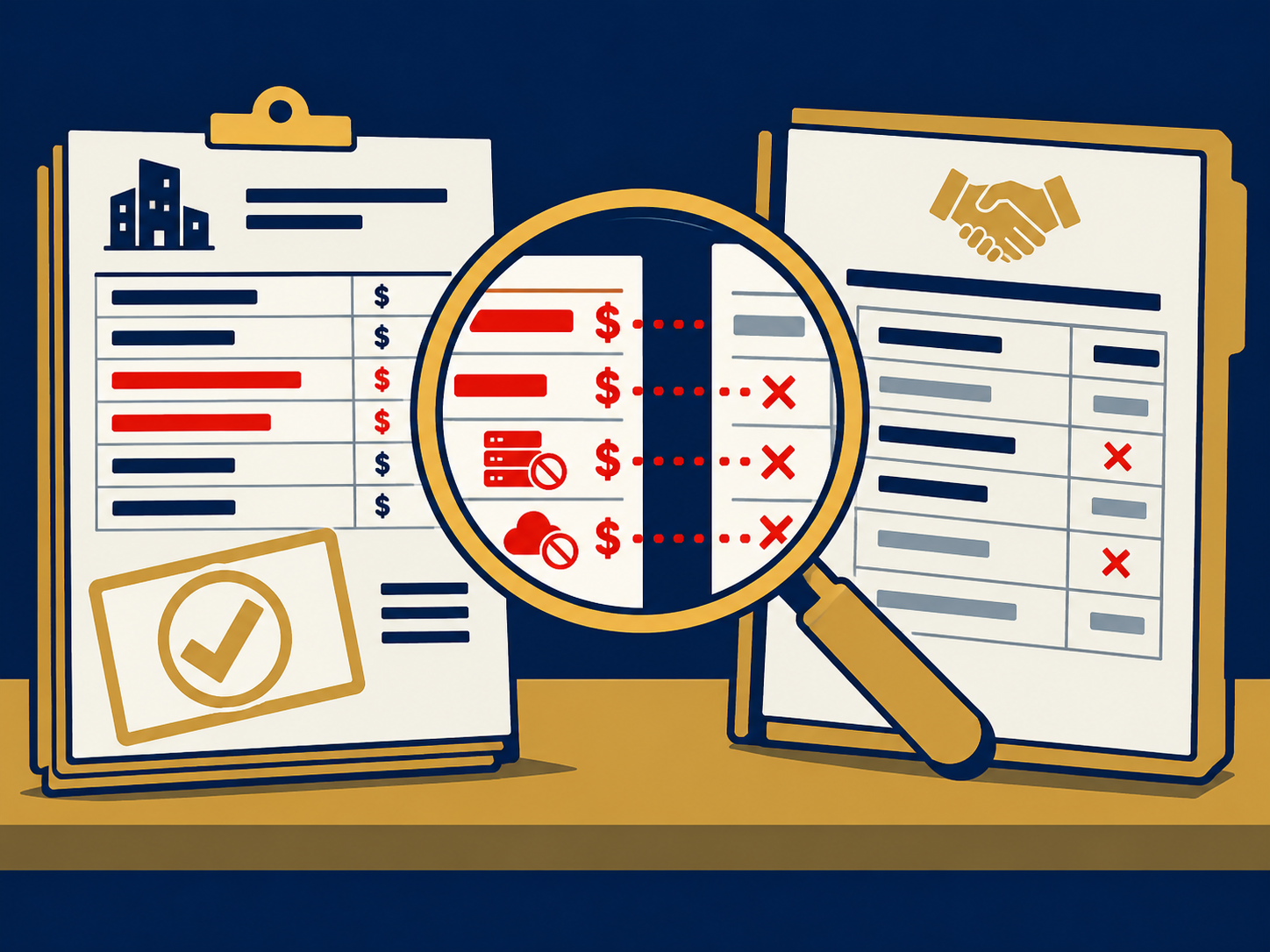
How the calculation works
Each line type is one row: the number of lines and the current cost per line a month.
- Current monthly cost = Σ lines × cost per line, across the rows you fill in.
- Replacement monthly cost = total lines × the replacement cost per line.
- Monthly savings = current − replacement. Annual savings = monthly savings × 12.
- Payback = one-time cost ÷ monthly savings, in months. There is no payback when the replacement costs as much or more each month.
- Net over 36 months = monthly savings × 36 − one-time cost.
Assumptions: prices stay flat, every line moves to the replacement at the same price, and the one-time cost is paid up front. Results are rounded to the cent. If your quote prices some line types differently (a fire panel that needs two paths, for example), run the calculator once per price.
Worked example
A property manager has 13 copper lines across a building and a quote of $35 per line a month with $4,800 of one-time hardware and installation:
| Line type | Lines | Cost per line a month | Monthly |
|---|---|---|---|
| Alarm and security panels | 6 | $62.50 | $375 |
| Elevator phones | 3 | $75.00 | $225 |
| Fax machines | 2 | $55.00 | $110 |
| Fire alarm panels | 2 | $68.00 | $136 |
- Today: $846 a month ($10,152 a year).
- Replacement: 13 × $35 = $455 a month.
- Savings: $391 a month, $4,692 a year.
- Payback: $4,800 ÷ $391 = 12.3 months.
- Net over 36 months: $391 × 36 − $4,800 = $9,276.
Copper retirement and the FCC
Carriers have been moving customers off copper networks and the analog services that run on them. In March 2026 the FCC adopted the Network and Services Modernization Order (FCC 26-19, WC Docket Nos. 25-208 and 25-209, adopted March 26 and released March 27, 2026). According to the order and the FCC fact sheet, it:
- grants carriers blanket section 214(a) authority to grandfather any legacy voice service, lower-speed data service and interconnected VoIP provisioned over copper wire, so they no longer file an application to stop taking new orders for them;
- adopts one consolidated rule for technology-transition discontinuance applications, and applies the 31-day automatic grant period to every discontinuance application;
- eliminates the filing requirements in the network change disclosure rules;
- finds that state or local requirements that conflict with this discontinuance framework are subject to preemption.
Carriers must still notify customers of a discontinuance application no later than the date they file it. The Federal Register notice sets October 15, 2026 as the effective date of the rule amendments. On life-safety lines, the order notes that the 2016 requirement for replacement services to be compatible with alarm and medical monitoring devices sunset in 2025, declines to add a new compatibility condition for alarm signaling, and encourages carriers to configure their IP networks to prevent alarm signaling failures.
This is context, not legal advice: what happens to a given line depends on the carrier’s filings for your area. A carrier notice is the usual trigger to price a replacement; see POTS replacement for the options.