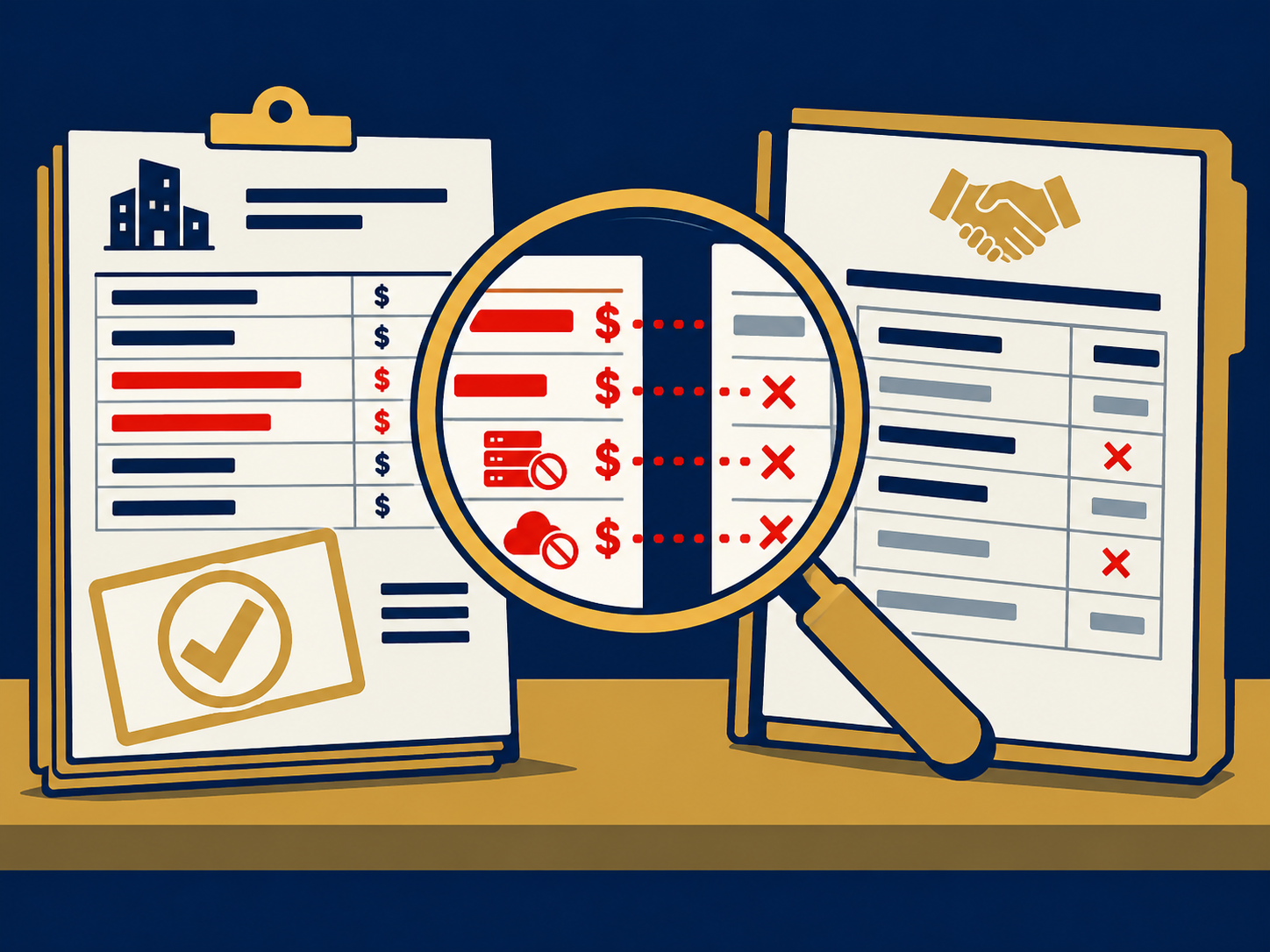

Your telecom invoice may include taxes, surcharges and provider fees that weren’t included in the quoted monthly rate, and a renewal is when you can still change how those charges are set. To check them, compare each charge to what the contract allows, sort it by who controls it, and test the federal Universal Service Fund (USF) line against its legal ceiling. Then use what you find to limit how the provider can change fees in the next term.
A charge that looks official isn’t necessarily required by the government, but that doesn’t make it improper. A provider can have the contractual right to charge a disclosed fee. Before you challenge anything, find out who controls the charge, how it’s calculated and what your agreement says.
Start With What the Contract Allows
Pull your latest invoice, the signed agreement and any service schedules or pricing documents. For each tax, fee and surcharge, check whether the contract names it or gives the provider the right to add or change it. Look closely at language on regulatory cost recovery, administrative fees, price adjustments and changes made with notice.
A charge can be allowed by the agreement even when no government requires it. That decides whether you have a possible billing error or a contract term to negotiate. If a charge appears on the invoice and you can’t find it in the agreement, ask the provider to identify the provision that authorizes it.
Separate Government Taxes From Provider Charges
Not every line labeled regulatory, recovery or compliance is a government tax. Federal, state and local authorities impose some taxes and assessments. A provider can also recover certain regulatory costs from customers, and it sets other fees, such as administrative or processing charges, on its own. For definitions, see telecom taxes and surcharges.
Sort every line into one of three groups.
| Charge type | What to verify |
|---|---|
| Taxes and assessments imposed by a government | The taxing authority, the service it applies to, the rate and any exemption |
| Regulatory cost recovery charges | The recovery rule, the calculation and the contract terms |
| Fees the provider sets | The contract authorization, the amount and the provider’s right to change it |
If you can’t place a line in a group, ask for a written explanation. The point is to know which charges are required, which follow regulatory rules and which your agreement controls, not to dispute every fee.
Check the Federal USF Calculation
The federal USF line has a specific calculation limit you can check. Providers contribute to the fund and can recover that cost from customers, but the FCC doesn’t require a separate USF line on your bill. When a provider does bill one, 47 CFR 54.712 limits it to the interstate telecommunications portion of your bill multiplied by the quarterly contribution factor.
The factor was 38.8% in the third quarter of 2026, according to the Universal Service Administrative Company (USAC) contribution factor page. The FCC announced 42.0% for the fourth quarter in public notice DA 26 946. That does not mean the provider can add 42% to your whole invoice. The percentage applies only to the interstate portion.
Here are two illustrations of the ceiling, not estimates of what a business should pay. If $1,000 of your bill is interstate telecommunications service, the most the USF line can be at the announced 42.0% is $420. If the interstate portion is $300, the ceiling is $126.
To check your own bill, ask the provider for the interstate amount it used and the factor it applied, then compare the result with the USF line. If the numbers don’t reconcile, ask for a written breakdown. The Universal Service Fund glossary entry explains why the line moves from quarter to quarter.
Question Fees the Provider Controls
Administrative and regulatory recovery fees deserve attention because their names sound mandatory. Start by asking whether a government imposes the charge or the provider assesses it. If the provider does, ask for the contract provision behind it, the current amount and the conditions under which it can increase.
Then read the agreement. Does it let the provider add new fees? Can existing fees rise without a stated limit? Is notice required, and can you end the service if charges change? A provider can have the right to assess a fee, so the practical move is to negotiate limits in a new agreement or renewal. Removing an open ended fee clause is worth more than arguing one month’s charge.
Review the First Invoice Against the Agreement
The first invoice after an installation, migration or renewal shows whether billing matches what was agreed. Compare it with the signed order and pricing schedule, and look for unexpected fees, wrong quantities, overlapping billing periods and charges that weren’t in the approved pricing. Even after you’ve negotiated the fee language, check the first invoice to make sure the provider billed according to the agreement. That check comes before any dispute. For method, see how to audit a technology invoice.
Send the provider a request like this:
Please identify each tax, fee and surcharge on our invoice. For charges imposed by a government, provide the taxing authority and the calculation basis. For charges the provider sets, identify the contract provision that applies and explain how the amount is determined. For the federal Universal Service Fund line, please provide the interstate telecommunications portion of the bill and the quarterly contribution factor used.
Keep the response with your contract and billing records. If a charge is wrong, dispute it within the deadline in your agreement, and don’t assume the provider will credit older invoices on its own. If your organization qualifies for a tax exemption, ask which certificates the provider needs and confirm they were applied to the right accounts and services. Eligibility depends on the tax, the jurisdiction and your circumstances.
Set the Rules Before You Renew
An invoice review finds problems. The contract decides how much control you have over future charges. Before you sign or renew, ask the provider to answer five questions in writing:
- Which taxes, surcharges and provider fees can be added to the agreed rates?
- Which fees have fixed amounts, and which can change?
- What notice must the provider give before it adds or increases a fee?
- Can you dispute or end the affected services if a material new charge appears?
- How long do you have to dispute an invoice or request a correction?
Have counsel review the language, especially where the provider reserves broad rights to change charges. You can’t prevent changes in government taxes or regulatory assessments. You can negotiate how the provider discloses, calculates and changes the fees it controls.
Before your next telecom renewal, set your current invoices next to the contract and list the charges you can’t verify and the clauses that leave future increases open. Those are the items to settle while you still have leverage. If a contract renewal is close, ITBroker.com’s telecom expense management can review the charges and terms with you before you sign.