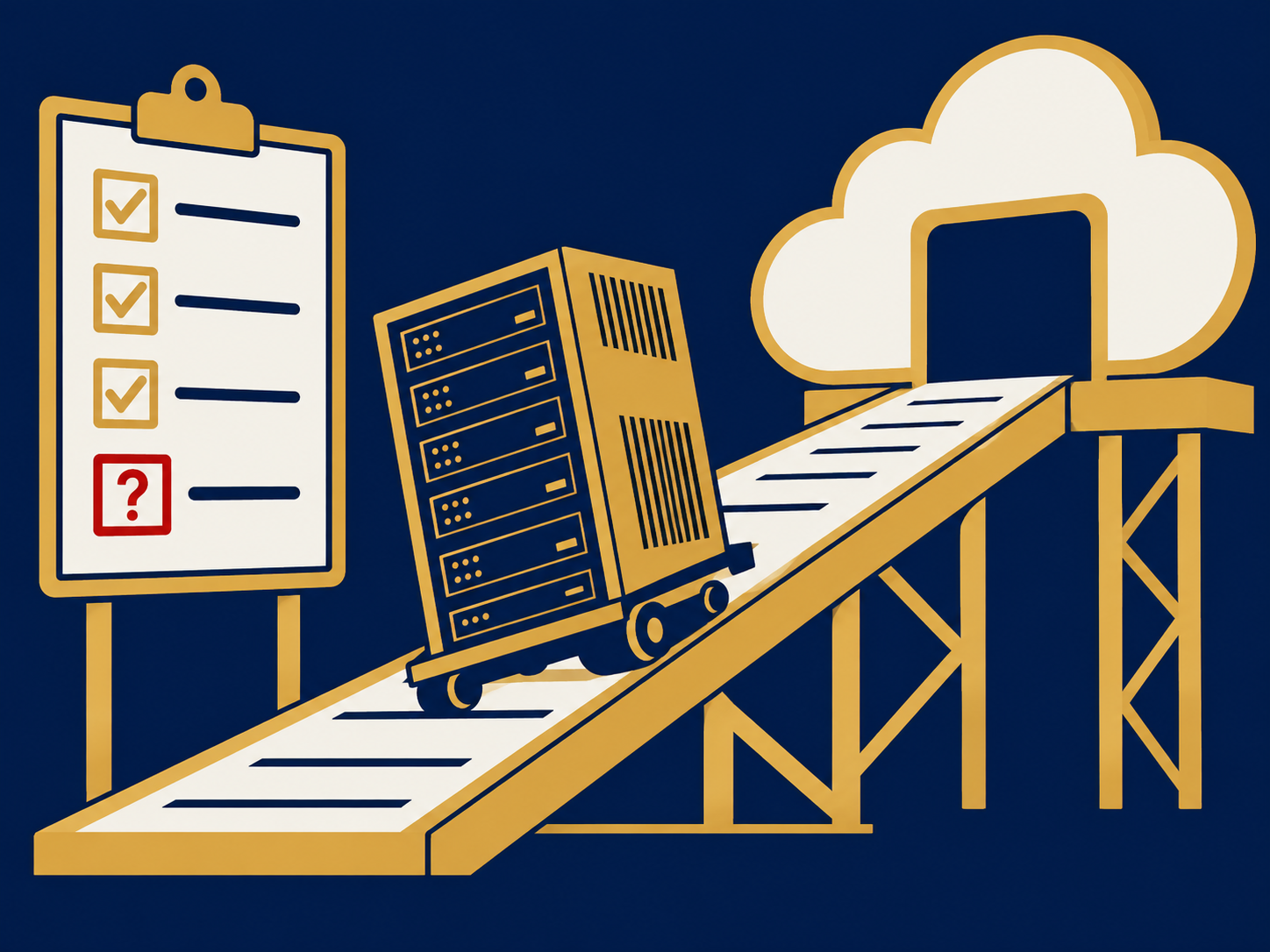

A data center build quote prices the room, and a colocation quote prices the space. Neither prices the next ten years on equal terms, and that’s the comparison your CFO will ask for.
Is it cheaper to build your own data center or to colocate? It depends on what you’re comparing, and most first comparisons aren’t like for like. One number helps you screen: your break even colocation price, the most you could pay per rack each month before building your own would cost less over ten years. If your colocation quotes come in under it, colocating is cheaper on cost, provided both options meet the same requirements for power, cooling, availability, network access and timing. If they don’t, building deserves a real look.
To run your own numbers, download the free Build vs. Colocate spreadsheet. It works out your break even colocation price over ten years and lines up real quotes side by side.
The question on the table usually sounds different. Should we build so we own it, or sign the colocation quote we already have? The real question is what it costs to keep your equipment safe, powered and connected for ten years, and who should carry the facility risk.
What a data center build quote leaves out
A construction estimate covers the room: power distribution, generators, UPS gear, cooling, racks and floor. Everything it takes to run that room for the next ten years lands somewhere else in your budget.
- Generator permits, testing and a fuel contract.
- Cooling maintenance, filters and coolant.
- Fire suppression inspection and testing.
- Facilities staff for the electrical and mechanical systems. That’s a facilities skill, not an IT skill.
- UPS battery replacements, often before the equipment is fully depreciated.
- Electricity overhead. A Lawrence Berkeley National Laboratory field study measured small server rooms at a PUE of 1.5 to 2.1: 50 cents to $1.10 in cooling and overhead for every dollar of server power. A room with 20 kW of IT load (the average power the servers draw) at 14.47 cents per kWh and a PUE of 1.8 spends about $45,600 a year on electricity, about $20,300 of it overhead.
- A network loop from your building into a carrier data center, because that’s where the networks are.
- Growth. When you need more power or space, the room can’t stretch, so expansion means another project.
None of that is in the construction number. In our cost model’s planning ranges, those lines add about $85,000 to $265,000 in the first year for a four rack room, before any battery replacement. How the build is financed and depreciated matters too, but that’s a question for your finance team, not part of a cash cost comparison.
What a colocation quote leaves out
Colocation quotes have gaps too. Power may be billed on a take or pay floor, on the capacity you reserve rather than what you use, and metered energy can sit on top of the space rate. Cross connects, extra remote hands, setup fees, migration and the link from your office all come on top. Billing can also start before the space is ready.
Work out your break even colocation price in five minutes
You need three numbers: what building costs over ten years, what colocation adds on top of the rack price, and your rack count.
- Add up the ten year build cost: the construction quote, any migration, and ten years of the running costs above.
- Subtract ten years of colocation costs other than the rack rate: setup, migration, cross connects, remote hands and the connection from your office.
- Divide what’s left by your rack count times 138.
That’s your break even price per rack per month. The 138 is 120 months adjusted for a 3% yearly price increase. If your colocation price is fixed for the full term, use 120. This is a screening shortcut: it assumes the colocation price is all in, space and power, for the same usable power, with one escalator for the term.
Here’s an illustrative example, run through our cost model with typical planning assumptions. Take a four rack room with 20 kW of IT load and a $400,000 build quote. Ten years of running it adds about $1.8 million, for a ten year total of about $2.2 million. Ten years of colocation extras come to about $480,000. That leaves about $1.7 million, and divided by 4 racks times 138, the break even price is about $3,100 per rack per month. A colocation quote at $2,500 a rack, all in for the same 20 kW, comes out about $330,000 cheaper over ten years on cost.
Now change the assumptions. If your running costs sit at the low end of our ranges, with an efficient room, cheaper upkeep and little staff time, the break even price drops to about $2,200. At $2,500 a rack, building would come out about $170,000 ahead.
Building can win when the quote is low, the running costs are low, and colocation in your market is expensive. The break even price shows you which of those holds for you, and which assumption would flip the answer.
Check requirements before you compare prices
A cheaper option isn’t a real option if it can’t do the job. Before comparing totals, confirm each option has:
- Enough usable power and cooling at your rack density.
- An availability and maintenance design that meets your need.
- The carriers and data residency you need, with latency tested using your own applications.
- A ready for service date that works for you, in writing.
- An expansion path on acceptable terms.
Then put the proposals side by side on the same usable power, redundancy and scope. Three quotes with different power commitments and billing aren’t three comparable prices. If you already have a room, what it cost to build is already spent. Compare the upgrades you’d need now plus ten years of running it against the cost of moving.
If the objection is speed, test it rather than assume it either way. Measure your applications’ real latency, dependencies and jitter over the actual route before you rule an option in or out.
What changed in 2026: building costs more, and terms matter more
For large, modern facilities, build costs now average $17.6 million per megawatt, up 21% since Cushman & Wakefield’s previous cost guide. That’s a different scale from a server room, but construction costs are climbing fast.
Colocation got tighter at the same time. CBRE reports that primary market vacancy hit a record low of 1.4% in the first half of 2026, and rents rose in every size bracket it tracks, by 4.3% to 8.3%. CBRE also reports that take or pay floors, where tenants pay for 60% to 85% of allocated power even if they use less, are becoming increasingly common in the U.S., and that ready for service fit out dates are stretching from weeks to several months. Those figures describe large deployments, or don’t state a size, so they aren’t a price for a few racks. They do change your timing and your contract checklist.
Five terms to get in writing before you sign colocation
- The power floor. Are you paying for the power you use, or the power you’ve reserved?
- When billing starts, and what happens if the space is late.
- A cap on the yearly price increase. Model it over the full term, not just year one.
- The right to expand next to your space, with the terms stated now.
- A clear definition of the power you’re paying for: metered or breakered, and how much is usable with redundancy.
Put these in an email to every provider you’re talking to. How each one answers tells you a lot about the quote.
Price both options on equal terms
Neither option is automatically cheap. ITBroker normalizes quotes across 967 providers and reviews the contract terms with you. You still make the decision, with comparable numbers.
The free Build vs. Colocate spreadsheet runs the precise version of this math, with your ten year totals, your break even colocation price, low, typical and high cases, and a quote comparison worksheet. The Build vs. Colocate Decision Kit adds a short guide to the requirements check and the contract terms that can change the answer. If you already have real quotes, send them and we’ll compare them on the same terms. If you’re also weighing public cloud, colocation vs. cloud covers that side.
An office move is usually when this decision lands, because the server room has to go somewhere. If that’s where you are, start here. It covers what to decide before the lease and the network orders lock you in.
This applies to you right now if someone has put a construction estimate or a colocation quote in front of you, or if your current room is out of power, cooling or space.
Sources: Cushman & Wakefield, 2026 Data Center Development Cost Guide; CBRE, North America Data Center Trends H1 2026 (August 2026); U.S. Energy Information Administration, Electric Power Monthly, Table 5.3 (August 2026, preliminary); Lawrence Berkeley National Laboratory, Energy Efficiency in Small Server Rooms: Field Surveys and Findings (2014). The example uses planning assumptions from our cost model, not quotes.