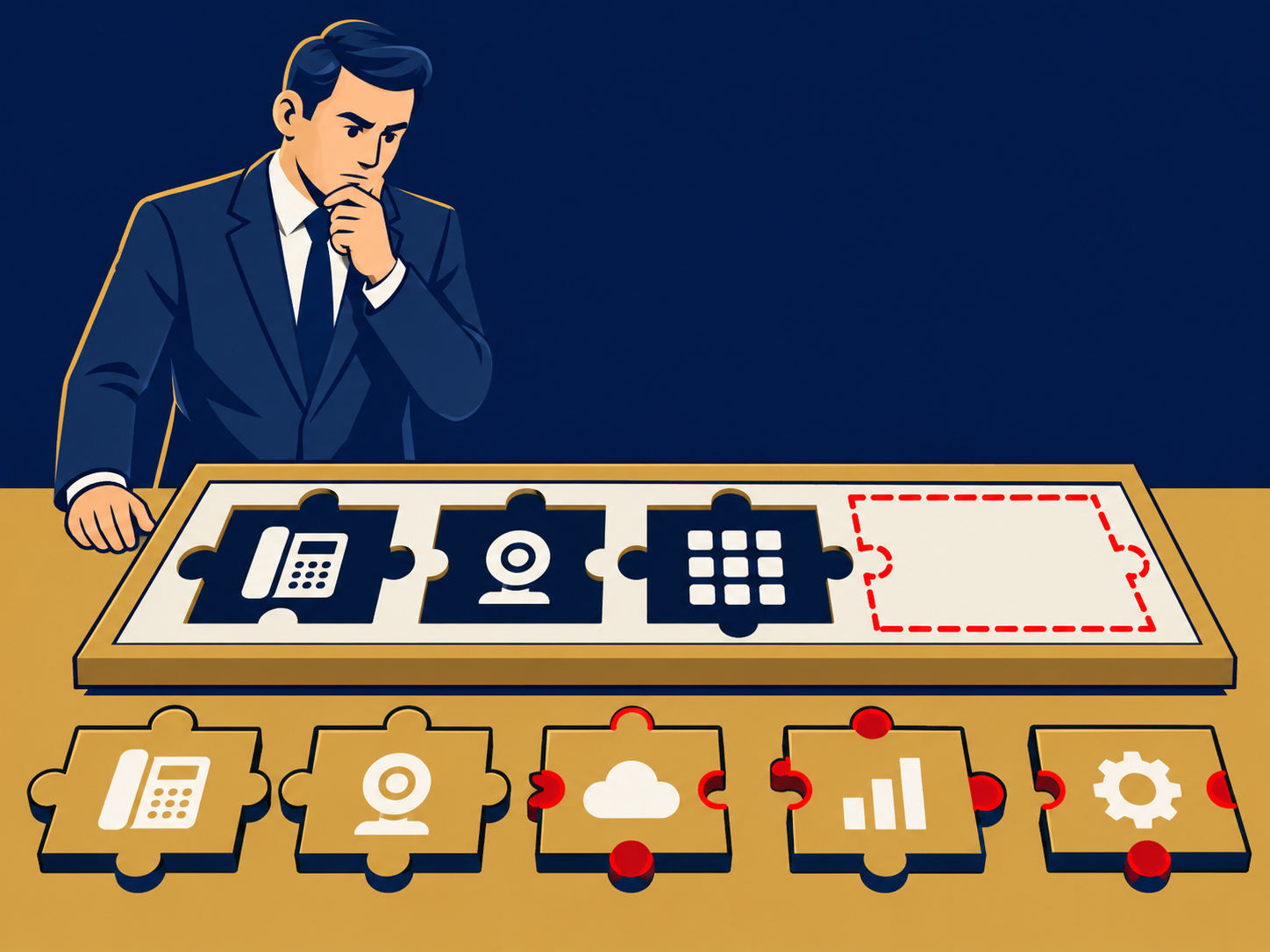
Max Clark: [00:07] This one’s going to be about modern phone systems, UCaaS as it’s referred to, and endpoint devices, the actual physical device on the desktop.
So you probably don’t care about any of this, so just skip forward, but I just need to get off my chest.
Microsoft Teams, Microsoft is just as much as like, I mean, I got intact in the late 90s, so Microsoft was the evil empire, and Microsoft did the most incredibly smart thing when they released Teams.
Microsoft created a partner certification program for the endpoint, for the physical device, the phone on the desktop, the conference room hardware, all these different things, and so you have Teams certified devices, and you can go through and you can get certified whether you’re selling a phone, or you’re selling a headset or whatever it is, right?
You have to go through and you have to get approved by Microsoft.
But what Microsoft did that was so amazing was they provided the software and the UI for the device.
So if you’re using Teams on your desktop, and then you go and you use Teams on your cell phone, or then you go and you use Teams on a physical phone, or you go use Teams in a conference room, Microsoft owns that UX, they own the user experience and the UI across the entire platform, and so the functionality is the same, the look and feel is the same, the experience is the same, and if you think about Microsoft, Microsoft does this very well.
They’ve created, they’ve commoditized the hardware manufacturer, and they provide the value in the software and the UI.
Does it sound familiar?
That’s Windows.
Windows commoditized the PC, so it didn’t matter if you were buying, back in the day, Gateway, Dell, PC, HP, Compact, whatever IBM, whatever it was, the hardware didn’t matter anymore.
It made no difference what it was in the hardware because it was Windows inside, and Windows is what you actually cared about, and so we see this with Teams and Teams endpoints.
Looking at the state of the voice world, the UCaaS world today, going back a few years, I thought Avaya was gonna be the one to do the same thing and actually really own this user experience market, and they released a very exciting update in software stack, and I was super stoked about it, and I think this was like 2000, 2000, yeah, this is pre-pandemic, so I wanna put this in 1999, 2019, 2020 timeline, but so they come out with this unified desktop experience with a mobile device, experience for iPhone and Android and tablet, and then show demos of this, or presentations of it running on their phones, and by the way, I’ve got one of their fancy phones down here on the desk here, this thing right here, this giant Android screen, I mean, it’s literally, it’s just a giant, giant screen.
Super excited, and so I forced Avaya to give me one, thank you Avaya for shipping me this stuff, and promptly turned it on and booted it up, and guess what?
They had shipped these things, and their platform required you to run their old interface, and the second I saw that, I just knew there was no chance for Avaya to actually figure this out or make it, like they just, was just gone.
Most UCaaS companies in the market today are really only pushing or selling, if you want a physical endpoint, your options are Polly, which is now, which might tell tried to buy, but couldn’t, which is in HPE, HPE, HPE, HPE or HPE, I forget, bought Pollycom, Pollycom and Plantronics merged, become Polly, Polly’s an acquired by HPE.
Okay, gotta keep track of all this stuff, it gets really confusing very fast.
So Pollycom being Polly now, Polly being the dominant endpoint device, physical device on phones, they have nice touch screen phones, they look great.
Other one that came out which is really exploded was Yealink.
Yealink is, it makes a really pretty phone as well, very common, you know, cheaper than Polly, so super popular.
Does a lot of things, it’s also nice to the service provider and includes voice quality statistics without licensing.
It has a zero comp boot, so the phone can check in and with its registration server and say, hey, where am I supposed to check in?
So you’d have to physically configure every phone when you ship them out.
Getting too into the nerd details here probably.
You know, there’s like audio codes and SNOM and Grandstream and there’s other manufacturers out there, but they’re not really super, super relevant.
Pick a UCaaS company, you know, let’s just pick on the big names.
If you’re Ring Central, if you’re 8x8, if you’re Zoom, if you’re Dialpad, let’s just go down that list and you want, and people come to you and say, hey, we wanna actually run a physical phone on the desk.
You know, you’re going out and you’re getting, you know, again, they’re just buying Polly or they’re buying Yealink probably and Yealink and Polly control that experience and the phone company, the UCaaS provider is dependent on the device manufacturer to actually determine what features are enabled.
So how does the user directory work?
Well, that’s a Polly function.
How does blind transfer work?
That’s a Polly decision.
How does voicemail retrieval work?
That’s a, you know, Yealink’s decided.
How does, you know, so all these different things, you know, we’re in the hands of the device manufacturer versus the device, you know, the hands of the UCaaS company.
And when you look at the integrated vendors, so this was a via where they were making the phone system for on-prem and the phone system, you know, the phones, right?
Apple experience and MyTele was doing this and Shortel was doing this and these different companies were doing this.
But none of them really transitioned very well into their cloud services.
Avia got out of the business, they just said, we’re out.
Now, Avia will tell you that they’re adding value by overlaying their intellectual property on top of Ring central as a stack.
But I mean, asked to see a demo of their physical phone and what the UI and the physical phone is versus what the UI is from, from the Viya for the desktop.
You know, MyTele got completely out of the cloud space completely. They didn’t even attempt to overlay on somebody else. They just decided to run away from the whole thing. Might have, by the way, made a really cool phone, which is this one up here. You can’t see, but I can’t point behind me very well. Anyways, this one up here on this desk. They had a really cool phone, wireless receivers, nice big colored touch screens, Bluetooth built in, all these different things, great phone, but same thing. Now they don’t own the underlying platform. They can’t… The interface between the phone and the UX of the soft phone, don’t jive and don’t connect. Cisco still has a Cisco WebEx calling. It’s out there in the market. You can go to… You can move an on-premise Cisco call manager, CUCM to an HCS platform and use the phones. You can also go to Cisco WebEx calling. Just connect the experience between the phone and the soft phone. What’s running on your desktop and what’s running on your cell phone? I’m really cool voice. The cool voice doesn’t even count because they don’t care. I think they just put this product up there to say that they have it and whatever suckers buy it by it. When I look at this and I think about this and start talking about where would you actually invest? What company would I buy stock in and how would I actually decide? Part of that is you can look at it from an intellectual property. You can say R&D. You can say sales velocity. You can say market share acquisition. What’s their percentage of TAM? What’s their percentage of growth? These are all things that you look at. From a technology standpoint, I look at it in terms of who’s actually looking down the road and trying to actually capture and provide an integrated experience for the user because these are the things that actually end up winning. At some point, if you’re interacting with a phone system and you’re using just the poly or Yalink device on your desktop and you’re not using a soft phone from that provider and you’re not using the admin interface, your experience with that phone system is a poly and everything behind it is completely interchangeable. It doesn’t matter what you’re running at that point because you don’t see it. You don’t experience it. There’s no connection to it.
There’s no affinity to it. There’s no value to it. It’s just like what provides and what makes that phone work? This drives a lot of commoditization and pricing pressure down. Now if you control the experience and then you say this is the experience that I want to buy. I want to buy this experience. The only place I can go and get this experience is from this company that provides differentiation and value and it doesn’t lead to price erosion. I’m curious to see if any of these UCaaS providers actually take this step. There’s a certain sense that physical phones are dead and then it’s just a matter of time before nobody uses them anymore. To a certain degree, maybe that’s true. This also comes from the whole idea of the whole entire world went to work from home and is never going back to the office. The second that you have people going back into office and you start talking about RTO, you can talk about if it’s RTO from the standpoint of hot desking, you can hot desk phones on desks. Hot desking doesn’t apply to most enterprise users and most knowledge workers. Now you’re still talking about a person who has a designated physical spot and that person has a designated physical phone.
I kind of feel like physical phones are going to make a resurgence here. I’m not betting money on this. Actually, I’ll bet some money on it. If you want to take a bet with me about whether or not physical phones are going to die or come back, reach out and we’ll set up a deal. Set up a side bet. I don’t know, we’ll do something silly. But that device and that ownership of that user experience outside of Microsoft Teams, I kind of feel like maybe Zoom would be the first one to really do this and to figure it out because they’ve got Zoom rooms and they’ve got a good hardware manufacturer program and they’ve got a lot of interaction with that stuff and they’re probably the ones that I would do this the first. Now it comes into a good strategy because Zoom wants to push people to desktop with a video. You can have that experience also running on a physical device. It’s like sitting on a desk. It’s always there and they have their big screens and big monitors and I kind of wonder if Zoom’s going to do it. It’d be interesting to be a fly on the wall and some of the conversations are going on inside. But when we counsel clients on phone systems and we start talking about these things, the stuff that we’re really looking for and I’m looking for and talking about is a lot of it’s not like what other platforms are you’re integrating with? You have a CRM you have to have an integrate with. You have equipment in the office. Do you have paging systems or door access gate control systems or do you have existing conference room hardware that you really care about? Are you running Windows or Mac on the desktop and what do you have for your cell phone fleet and what’s your mobile and what are people doing? All that kind of stuff. What is your user’s experience? What are they going to experience day to day? How do you provide a good experience for your users? How do you make people happy? How do you make them feel like that they have sophisticated advanced cutting edge experience because this is a big thing for you. Nobody wants to come into an office and feel like they’ve just stepped back in time 10, 15 years. If you’re providing an experience, it really feels like you’re going backwards in time. People look at the company. It’s this thing of like, oh my, we’re so backwaters here. A lot of that is just what people experience when they sit down and they interact. Are they getting modern equipment? Are they getting modern experience? Anyway, so like I said, a lot of inside baseball here in terms of devices and phones. It’s great that a lot of these devices have gone touchscreen. It’s kind of like this when the iPhone came out and all of a sudden everything went touchscreen. The touch screens that exist today, a lot of them are just touchscreen representations of what were buttons beforehand and the UX hasn’t really been changed and I’m really hoping it does. I’m hoping somebody figures it out because it’s going to be really cool when this happens. It’s going to be really cool when this comes out and somebody else is a market coin really head to head with Microsoft on I’m providing, you know, a seamless end to end environment. So I’m Max Clark. That’s not quite 20 minutes, but that was 20 minutes Max.