How the calculation works
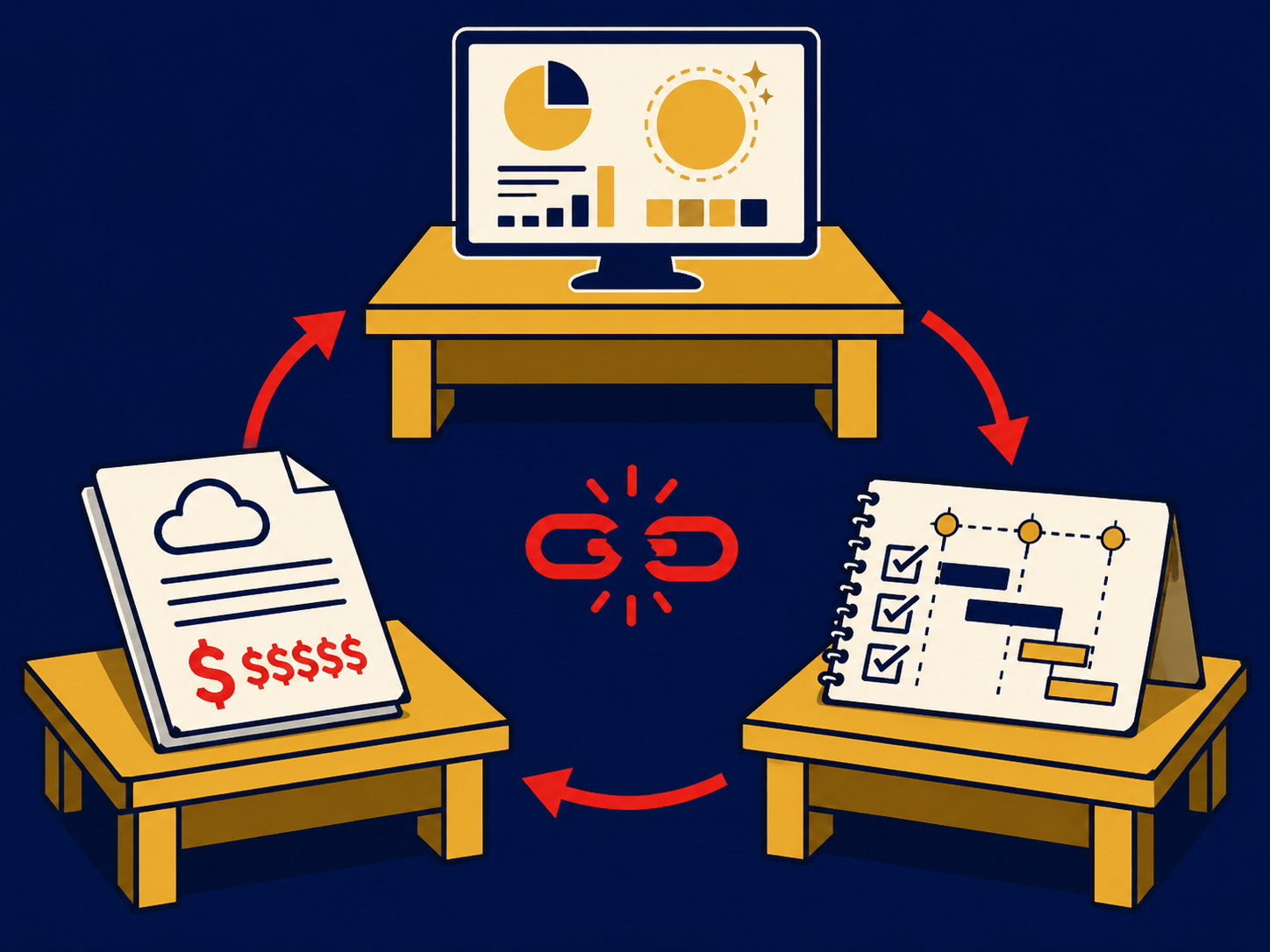
Each option has one-time costs, a recurring cost, staff time and an exit cost. Over a period of N years, the calculator works out:
- One-time costs = upfront purchase + migration or onboarding, paid at the start.
- Recurring cost in year k = the annual amount (12 × a monthly amount) × (1 + escalator)k − 1. The escalator applies at the start of each year after the first.
- Staff cost in year k = hours a month × loaded hourly rate × 12 × (1 + wage growth)k − 1.
- Exit cost is paid once, at the end of year N.
- Total = one-time costs + every year’s recurring and staff costs + exit.
- Present value (with a discount rate d) = one-time costs + each year’s costs ÷ (1 + d)k. One-time costs happen now and each year’s costs are counted at the end of that year, the same convention as a spreadsheet’s NPV function plus the amount spent today. Because monthly bills are paid through the year, this discounts them slightly more than a month-by-month calculation would.
The cheapest option is the one with the lowest present value when you give a discount rate, and the lowest total when you don’t. Break-even compares the cheapest option with each of the others month by month, without discounting: it is the first month from which the cheapest option’s running total stays at or below the other’s through the end of the period, with each year’s costs spread evenly over its 12 months and exit costs added at the end.
Leave out costs that are identical for every option. Taxes, depreciation and financing are not modeled; for a buy-or-lease decision on one asset, use the lease vs buy calculator.
Worked example
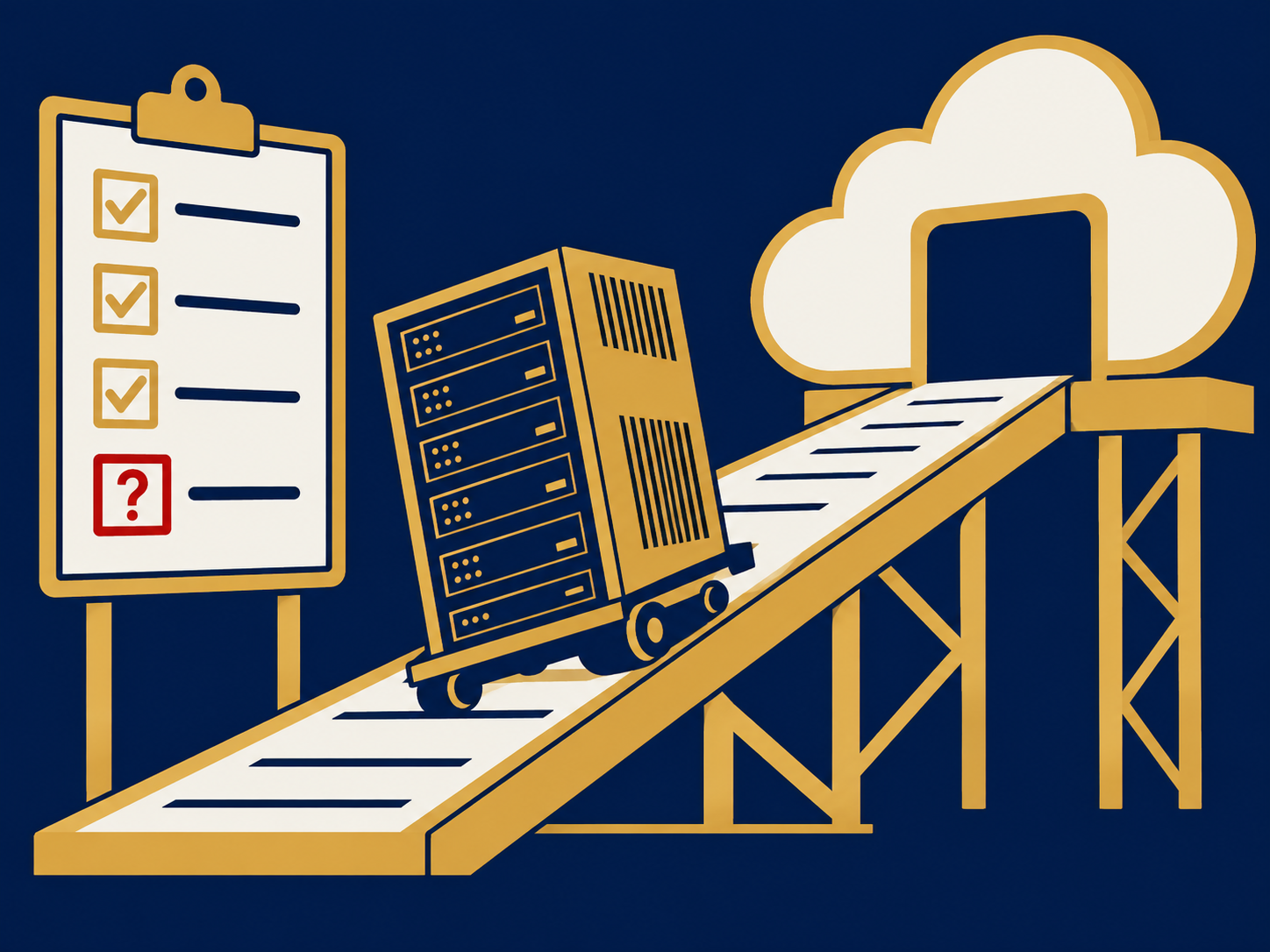
A company is deciding whether to refresh its on-premises servers or move the workload to a hosted platform, over 5 years with an 8% discount rate.
- Option 1, refresh on-premises: $120,000 of hardware and $10,000 of migration work, $5,000 to decommission at the end; $1,500 a month of support and colocation, rising 3% a year; 40 staff hours a month at a loaded $85 an hour, with wages rising 3% a year.
- Option 2, hosted: no hardware, $25,000 to migrate and $15,000 to leave at the end; $5,500 a month, rising 4% a year; 15 staff hours a month at $85, rising 3%.
Year by year, Option 1 costs $58,800 (18,000 of support plus 40 × $85 × 12 = $40,800 of staff time), then $60,564, $62,381, $64,252 and $71,180 including the exit cost. Option 2 costs $81,300 in year 1 (66,000 + 15,300), rising to $109,431 in year 5 with its exit cost.
- Totals over 5 years: Option 1 $447,177, Option 2 $478,707.
- Present value at 8%: Option 1 $381,560, Option 2 $383,525. Option 1 is cheapest by $1,965.
- Break-even: Option 1 starts $105,000 behind on one-time costs and closes the gap by $22,500 to $28,251 a year. It catches up in month 51, in year 5.
On totals Option 1 wins by more than $31,000, but on present value the gap shrinks to under $2,000, because most of Option 1’s cost is spent on day one. The answer turns around easily: at a 9% discount rate Option 2 is cheaper by $1,028, and over 4 years at 8% it is cheaper by $16,717. That is worth knowing before you commit.
Getting the inputs right
- Use quoted prices, not list prices, and include the escalators in the contracts you’d sign. The price escalator calculator shows what an escalator adds on its own.
- Ask for exit costs up front. Data egress, early-termination fees and the work to move again are easy to leave out and can change the result.
- Count the hours honestly. Ask the people who would run each option, and include on-call and vendor management time.
- Pick the discount rate with finance. Most companies use a cost of capital or hurdle rate; the result tells you how sensitive the answer is to it.