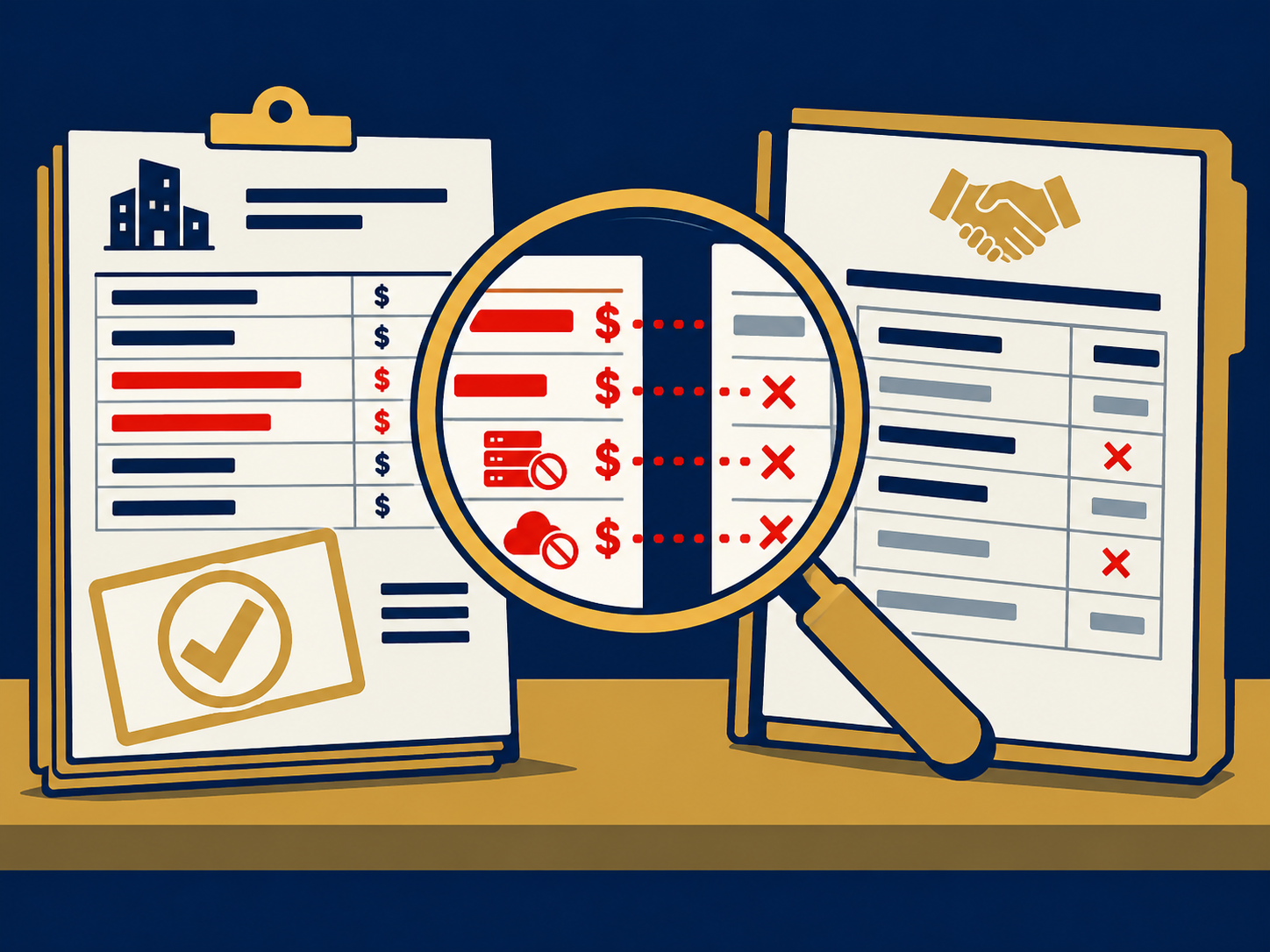
How the calculation works
For each category with monthly spend S and your planning assumption of L% to H%:
- Annual spend = S × 12.
- Savings range = annual spend × L ÷ 100 to annual spend × H ÷ 100, a year.
The total adds every category you entered. The same assumption applies to every category; the defaults are 3% and 10%, a cautious starting point we chose, not a benchmark.
Contract status sorts the range by when you can act on it, without changing its size:
- Negotiable now: month-to-month, or renewing within 6 months. Rates can be renegotiated or the service re-bid before you commit again.
- In term: billing errors can be disputed and unused services disconnected now; rate changes usually wait for the renewal.
- Status unknown: find the term end and notice dates first. The contract renewal calculator works out the notice deadline.
Assumptions: spend is what you pay a month today, taxes and surcharges included if that is how you budget. The range is ongoing savings a year at today’s spend. It doesn’t include one-time recoveries of past overbilling, early termination fees, or the cost of the audit itself.
Worked example
A company with four categories under contract, using the default 3% to 10%:
| Category | Monthly spend | Contract status | Annual spend | Savings range a year |
|---|---|---|---|---|
| Internet and WAN | $4,500 | Month-to-month | $54,000 | $1,620 to $5,400 |
| Voice and UCaaS | $3,200 | In term | $38,400 | $1,152 to $3,840 |
| Mobile | $2,800 | Renewing within 6 months | $33,600 | $1,008 to $3,360 |
| Cloud and SaaS | $6,000 | Not sure | $72,000 | $2,160 to $7,200 |
- Total: $16,500 a month, $198,000 a year, so a savings range of $5,940 to $19,800 a year ($495 to $1,650 a month).
- Negotiable now: internet and mobile, 44.2% of spend: $2,628 to $8,760 a year.
- In term: voice, 19.4% of spend: $1,152 to $3,840 a year, mostly from billing errors and unused lines until the renewal.
- Status unknown: cloud and SaaS, 36.4% of spend: $2,160 to $7,200 a year once the contract dates are known.
What drives the range
Where an audit’s result lands inside (or outside) your range depends on what it finds. The usual sources:
- Billing errors. Charges above the contracted rate, one-time charges billed twice, services billed after a disconnect, and wrong taxes and surcharges. These are found by checking invoices against contracts and can be disputed within each provider’s dispute window.
- Unused lines and circuits. Services at closed sites, lines for departed staff, backup circuits nobody remembers and licenses nobody uses. An accurate telecom inventory finds them; confirm nothing depends on a line (alarms, elevators, fax) before disconnecting it.
- Out-of-term pricing. When a term ends, many services roll to month-to-month at the old rate or a higher list rate. Re-signing or re-bidding resets the price.
- Market rate changes. Prices for the same service change over a multi-year term. Comparing current quotes with what you pay shows whether the gap is worth acting on.
- Consolidation. Fewer providers, accounts or overlapping services, and co-terming contracts so they renew together, can lower prices and make the next negotiation easier.
A thorough audit is a one-time project; keeping the savings usually needs ongoing telecom expense management, and mobile lines often get a wireless expense management review of plans, pooling and unused devices.